


The Concept of Brotherhood of Hope in QS Al-Hujurat Verses 11-13 Perspective of the Interpretation of Al-Misbah and Al-Azhar
Abstract
This study aims to describe the concept of brotherhood of hope in QS Al-Hujurat verses 11-13, to describe the concept of brotherhood of hope in the Qur'an according to Tafsir al-Misbah and Tafsir al-Azhar in QS Al-Hujurat verses 11-13, describe the implications of brotherhood of hope in QS Al-Hujurat verses 11-13. The method used is library research with a comparative approach and the theory of meaning and understanding between Tafsir al-Misbah and Tafsir al-Azhar in QS al-Hujurat: 11-13. The data analysis process with data collection, data reduction and conclusions. This study explains that the siblinghood of hope is formed from several types of relationships, namely: traditional full sibling individuals who have the same biological parents, half sibling individuals who have one parent in common, step sibling individuals who do not have the same biological parents but have a relationship resulting from marriage between parents, adoptive sibling individuals who are legally adopted by a family, and fictive sibling individuals who have been related siblings. The brotherhood of hope according to M. Quraish Shihab is a brotherhood that is not limited to relationships between believers but across religions and social groups. According to Buya Hamka, the relationship is based on ideological similarities and one descent.
Keywords
Full Text:
PDFReferences
Abd. al-Hayy, al-Farmawi. Metode Tafsir Al-Maudhu’i. Raja Grafindo Persada, 1996.
Abuddin Nata. Tafsir Ayat-Ayat Pendidkan (Tafsir At-Tarbawi). Rajawali Press, 2012.
Al-Bukhari. Kitab al Adab. n.d.
Ali Ridho. “Internalisasi Nilai Pendidikan Ukhuwah Islamiyah, Menuju Perdamaian (Shulhu) Dalam Masyarakat Multikultural Perspektif Hadis.” At. Tajdid 01, no. 02 (2017).
Buya Hamka. Tafsir Al-Azhar Jilid 9. Pustaka Nasional PTE LTD, n.d.
Dendy Sugono. Kamus Bahasa Indonesia. Pusat Bahasa, 2008.
“Departemen Agama RI, Mushaf Al-Qur’an Terjemah.” Preprint, Al-Huda, 2002.
Dewi Sa’diah. “Implementasi Dakwah Dalam Menanamkan Nilai-Nilai Pendidikan Islam Untuk Membina Kepribadian Sehat.” Jurnal Anida 14, no. 2 (2015).
Dharma Setyawan and Dwi Nugroho. “The Socio-Religious Construction: The Religious Tolerance Among Salafi Muslim and Christian in Metro.” Dialoq 44, no. 2 (2021).
George Ritzer. Sosiologi Ilmu Pengetahuan Berparadigma Ganda, Terj. Alimandan. Rajawali, 1985.
Khairil Ikhsan Siregar. “Konsep Persaudaraan Sebagai Profetik Sunnah Dalam Perspektif Mahasiswa Fakultas Ilmu Sosial UNJ.” Jurnal Studi Al-Qur’an 14, no. 2 (2018).
“Lajnah Pentashih Mushaf Al Quran Departemen Agama Republik Indonesia, Al Quran Dan Terjemah.” Preprint, CV Penerbit Diponogoro, 2006.
M. Nazir. Metode Penelitian. Ghalia Indonesia, 1999.
M. Quraish Shihab. Membumikan Al-Quran. Mizan, 1998.
M. Quraish Shihab. Membumikan Al-Quran. Mizan, 1998.
M. Quraish Shihab. Tafsir Al-Misbah: Pesan, Kesan, Dan Keserasian Al-Quran. Lentera Hati, 2002.
M. Quraish Shihab. Wawasan Al-Qur’an Dan Tafsir Maudhu’I Atas Berbagai Persoalan Umat. Mizan, 1996.
Madina, Laila. “Nilai-Nilai Sosial Pada Tradisi Mawarung Di Kalimantan Selatan.” Seri Publikasi Pembelajaran 1, no. 1 (2023): 1–14.
Madjid, Nurcholish. Islam , Doktrin Dan Peradaban. 2006.
Madjid, Nurcholish. Islam, Doktrin, Dan Peradaban. Graha Paramadina, 2008.
Muh. Ali Bagas, et.al, . “Religious Tolerance Messages on Social Media: Insights from Deddy Corbuzier`s ‘Log in’ Program.” Al`Adalah: Journal of Islamic Studies 27, no. 1 (2024).
Mustafa, Hasan. Perilaku Manusia Dalam Perspektif Psikologi Sosial. 7, no. 2 (2012): 143–56.
Na’im & Syaputra. Kewarganegaraan, Suku Bangsa, Agama, Dan Bahasa Sehari-Hari Penduduk Indonesia Hasil Sensus Penduduk. Badan Pusat Statistik, 2010.
Nurcholis Madjid. Islam Universal. Pustaka Pelajar, 2007.
Prasanti & Indriani. “Pemaknaan Simbol Dalam Komunitas ‘Brotherhood’ (Konstruksi Makna Simbol Sebagai Identitas Diri Dalam Komunitas ‘Brotherhood’ Di Bandung).” Semiotika 10, no. 1 (2016).
Qushairi, Muslim bin Hujjaj bin Muslim bin. Shahih Muslim. Dar al-Salam, 1999.
Saifullah. “Konsepsi Pembinaan Kepribadian Sehat Pada Anak Dalam Keluarga.” Takamul: Jurnal Studi Gender Dan Islam Serta Perlindungan Anak 14, no. 2 (2015).
Sarwono, Sarlito W. “Teori-Teori Psikologi Sosial.” In PT. Rajagrafindo Persada. 2005.
Supriyanto. “Memahami Dan Mengukur Toleransi Dari Perspektif Psikologi Sosial.” PSIKOISLAMIKA 15, no. 2 (2017).
Verkuyten, M. & Yogesswaran, K. “The Social Psychology of Intergroup Toleration: A Roadmap For Theory And Research.” Personality and Social Psychology Review 21, no. 1 (2017).
Wajedi Ma`ruf. “Ukhuwah Dalam Al-Qur’an Dan Implementasinya Dalam Pendidikan Islam. Dirasat Islamiah.” Jurnal Kajian Keislaman 1, no. 2 (2020).
Yoga, Salman. “Perubahan Sosial Budaya Masyarakat Indonesia Dan Perkembangan Teknologi Komunikasi.” Jurnal Al-Bayan 24, no. 1 (2019).
Zabidi, Ahmad. “Kelompok Sosial Dalam Masyarakat Perspektif Qs. Al-Maidah Ayat 2.” Borneo : Journal of Islamic Studies 3, no. 2 (2020): 42–58. https://doi.org/10.37567/borneo.v3i2.262.
DOI: http://dx.doi.org/10.35931/aq.v20i1.5663
Refbacks
- There are currently no refbacks.
Copyright (c) 2025 Subli Ibrahim, Aris Fauzan, Halim Purnomo

This work is licensed under a Creative Commons Attribution 4.0 International License.
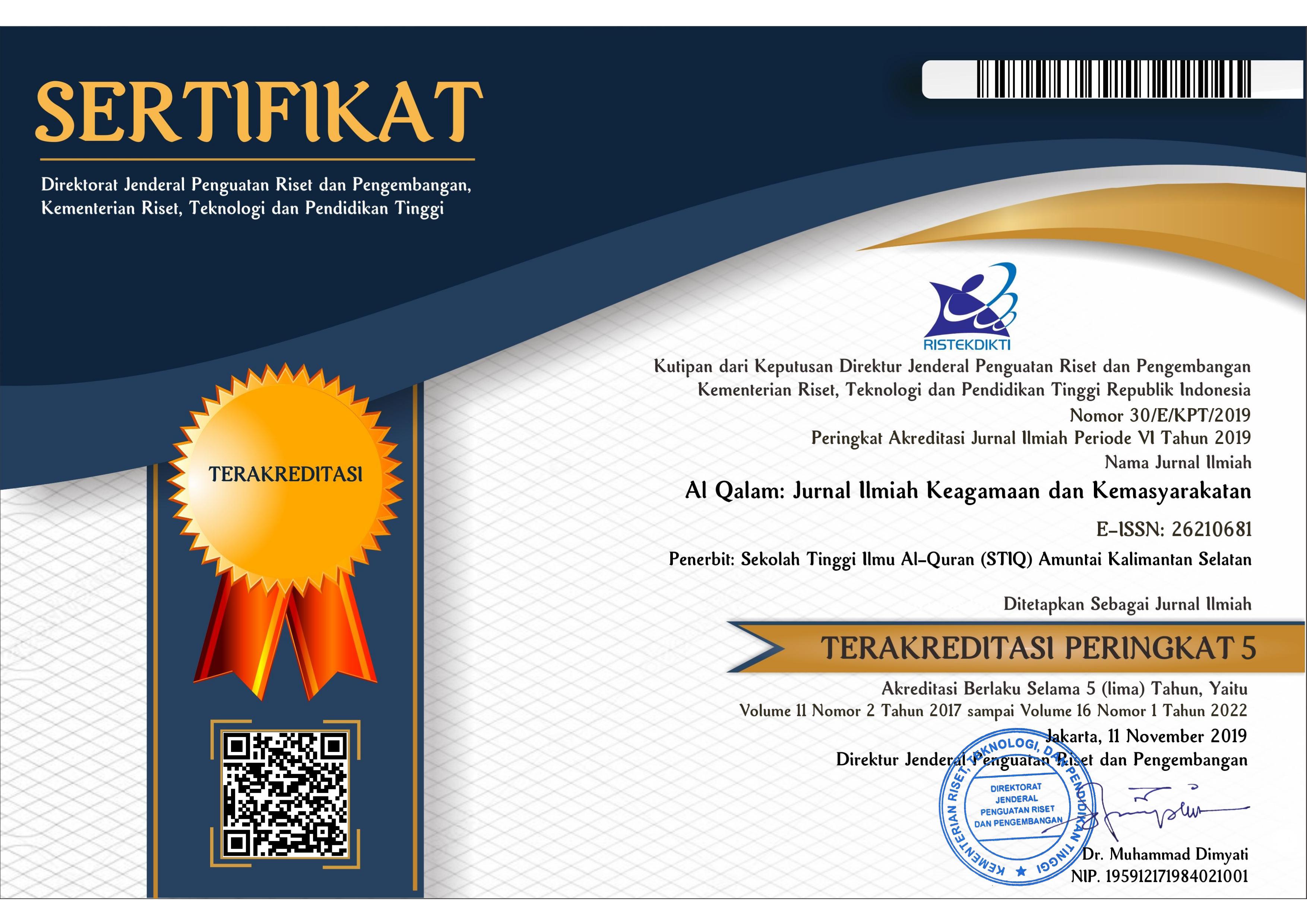
Al Qalam: Jurnal Ilmiah Keagamaan dan Kemasyarakatan
index by:










Publish by:
Sekolah Tinggi Ilmu Al-Qur'an Amuntai
Contact us:
Address: Jl. Rakha Pakapuran, Amuntai Utara
Kabupaten : Hulu Sungai Utara
Kode Pos : 71471
Provinsi : Kalimantan Selatan
Telephone : 085251613000
Email: hafizhihusinsungkar@gmail.com

This work is licensed under a Creative Commons Attribution 4.0 International License