


Goals and Methods of Islamic Education: Majid Irsan Al-Kailani's Perspective
Abstract
This study aims to: (1) Describe the biography of Majid Irsan Al-Kailani (2) Analyze the goals and methods of Islamic education from Majid Irsan Al-Kailani's perspective (3) Analyze the relevance of the development of goals and methods of Islamic education from Majid Irsan Al-Kailani's perspective with contemporary Islamic education. This type of research is qualitative research with library research method and figure study approach. The primary data source in this study is the book Ahdaf at-Tarbiyah al-Islamiyah Dirasah Muqaranah baina Ahdaf at-Tarbiyah al-Islamiyah wa al-Ahdaf at-Tarbawiyah al-Mu'asharah by Majid Irsan Al-Kailani and supported by Al-Kailani's works as well as books, journals, and scientific works related to the discussion in the study as secondary sources. The data analysis technique used is content analysis. The results of the study show that Majid Irsan Al-Kailani's thoughts on the goals and methods of Islamic education are very relevant to the present day. He formulated four main goals of education: the formation of good individuals (al-fard al-shalih), the Islamic family (al-usrah al-muslimah), the community of messengers (ummah al-risalah), and human brotherhood (al-ukhuwah al-insaniyah). All of these points culminate in the effort to produce complete human beings (al-insan al-kamil al-raqi) capable of realizing the vision of Islamic education by fostering a strong spiritual relationship between students and Allah SWT.
Keywords
Full Text:
PDFReferences
Al-Attas, Muhammad Naguib. “Konsep Pendidikan Dalam Islam.” (No Title), 1987.
Al-Attas, Muhammad Naquib. The Concept of Education in Islam. Muslim Youth Movement of Malaysia Kuala Lumpur, 1980.
Al-Kailani, Majid Arsan. “Ahdaf At-Tarbiyah Al-Islamiyah.” Herndon Virginia: The International, Institute of Islamic Though, 1997.
Anshori, Isa. “Dinamika Pesantren Muhammadiyah Dan Nahdlatul Ulama: Perspektif Sosial, Ideologi Dan Ekonomi.” Preprint, Nizamia Learning Center Ruko Valencia AA-15 Sidoarjo, 2020.
Azra, Azyumardi. Pendidikan Islam: Tradisi Dan Modernisasi Di Tengah Tantangan Milenium III. Prenada Media, 2019.
Azra, Azyumardi. Pendidikan Islam: Tradisi Dan Modernisasi Menuju Milenium Baru. Logos Wacana Ilmu, 1999.
Hashim, Azmil. “Persepsi Guru Pendidikan Islam Terhadap Ilmu Menurut Konsep Malakah Ilmiyyah Ibnu Khaldun.” Sains Humanika, 2018.
Indonesia, Departemen Agama Republik. “Al-Qur’an Dan Terjemahannya.” Bandung: Syamil Cipta Media, 2005.
Kalogiannidis, Stavros, Fotios Chatzitheodoridis, Dimitrios Kalfas, and Maria Paschalidou. “Assessing the Impact of Communication on Customer Relationship Marketing: A Case Study of Mobile Telecom Companies.” WSEAS Transactions on Business and Economics 20 (2022): 2713–28. https://doi.org/10.37394/23207.2023.20.231.
Kandasamy, Ramasamy, I Muhaimin, and Azme B Khamis. “Thermophoresis and Variable Viscosity Effects on MHD Mixed Convective Heat and Mass Transfer Past a Porous Wedge in the Presence of Chemical Reaction.” Heat and Mass Transfer 45, no. 6 (2009): 703–12.
Langgulung, Hasan. Asas-Asas Pendidikan Islam. Dewan Bahasa dan Pustaka, 1991.
Lexy, J Moleong. “Penelitian Kualitatif.” Bandung: PT Remaja Rosdakarya, 2008.
Makhzuniyah, Minhah, and Misyka Nuri Fatimah. “Differentiation Of Learning Styles In The Al-Qur’an: Analytical Study of Learning Stories in the Al-Quran.” IQ (Ilmu Al-Qur’an): Jurnal Pendidikan Islam 7, no. 01 (2024): 61–77.
Mas’ ud, Abdurrachman. Menggagas Format Pendidikan Nondikotomik:(Humanisme Religius Sebagai Paradigma Pendidikan Islam). Gama Media, 2002.
McCain, Carmen. “Islam and Modernity.” The Wiley‐Blackwell Companion to African Religions, Wiley Online Library, 2012, 355–64.
Nasution, Santi Riyati. “Pergeseran Nilai-Nilai Pendidikan Islam Di Kalangan Remaja Desa Mandasip Kecamatan Simangambat Kabupaten Padang Lawas Utara.” Preprint, UIN Syekh Ali Hasan Ahmad Addary Padangsidimpuan, 2024.
Nurandriani, Riri, and Sobar Alghazal. “Konsep Pendidikan Islam Menurut Ibnu Khaldun Dan Relevansinya Dengan Sistem Pendidikan Nasional.” Jurnal Riset Pendidikan Agama Islam, 2022, 27–36.
Pohan, Syafruddin, Annisa Ariftha, All Rizky Ramadhan, and Ahmad Saleh Afif. “Fenomena Lunturnya 3 Makna Kata (Tolong, Maaf Dan Terimakasih) Dalam Etika Komunikasi Di Kota Medan.” Da’watuna: Journal of Communication and Islamic Broadcasting 4, no. 1 (2024): 479–88.
Rakhmat, Jalaluddin. Islam Alternatif. Mizan, 1989.
Rofiqoh, Rofiqoh. “Perubahan Perilaku Remaja Pengikut Tarekat Naqsyabandiyah Syekh Muhammad Nur Ali Alkholidi Di Desa Hutapuli Kecamatan Siabu.” Preprint, UIN Syekh Ali Hasan Ahmad Addary Padangsidimpuan, 2023.
Salminawati, Salminawati. Filsafat Pendidikan Islam: Membangun Konsep Pendidikan Yang Islami. Citapustaka Media Perintis, 2011.
Siregar, L Hidayat. “Tarekat Naqsyabandiyah Syaikh Abdul Wahab Rokan: Sejarah, Ajaran, Amalan, Dan Dinamika Perubahan.” Miqot: Jurnal Ilmu-Ilmu Keislaman 35, no. 1 (2011): 131.
Sormin, Darliana, Mursal Aziz, Samsidar Samsidar, Muksana Muksana, Mira Rahmayanti, and Maesaroh Maesaroh. “Inovasi Pembaharuan Pendidikan Muhammadiyah.” Edukasi Islami: Jurnal Pendidikan Islam 11, no. 02 (2022).
Suhendri, Suhendri. “Meditasi Dalam Islam Analisis Ayat-Ayat Tafakur Dalam Tafsir Al-Azhar Dan Tafsȋr Ibnu Katsȋr.” Preprint, Institut PTIQ Jakarta, 2024.
Zed, Mestika. Metode Penelitian Kepustakaan. Yayasan Pustaka Obor Indonesia, 2008.
DOI: http://dx.doi.org/10.35931/aq.v20i1.5888
Refbacks
- There are currently no refbacks.
Copyright (c) 2025 M. Yunus Sinaga, Junaidi Arsyad, Salminawati Salminawati

This work is licensed under a Creative Commons Attribution 4.0 International License.
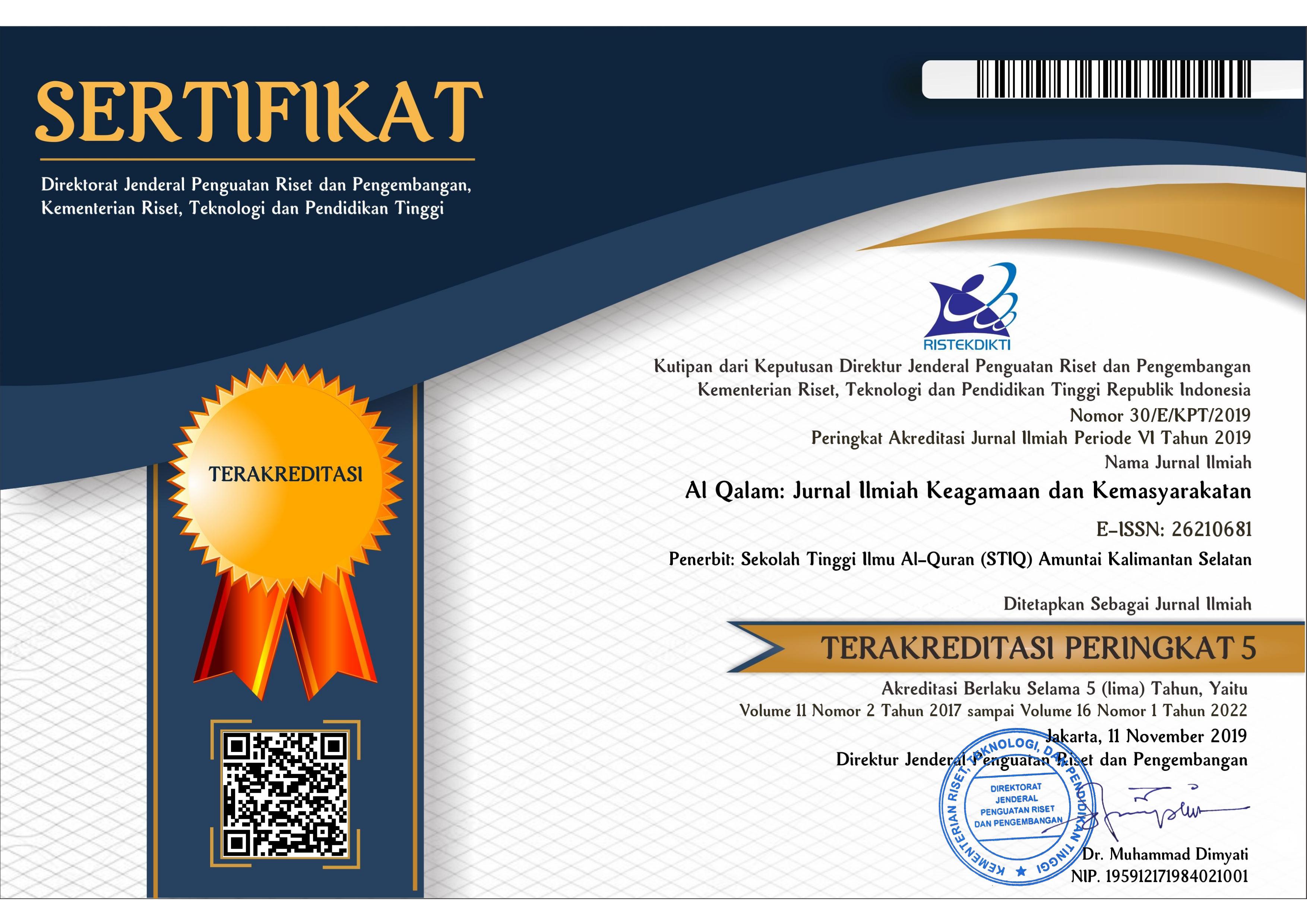
Al Qalam: Jurnal Ilmiah Keagamaan dan Kemasyarakatan
index by:










Publish by:
Sekolah Tinggi Ilmu Al-Qur'an Amuntai
Contact us:
Address: Jl. Rakha Pakapuran, Amuntai Utara
Kabupaten : Hulu Sungai Utara
Kode Pos : 71471
Provinsi : Kalimantan Selatan
Telephone : 085251613000
Email: hafizhihusinsungkar@gmail.com

This work is licensed under a Creative Commons Attribution 4.0 International License