


Japa Mantra and Offerings in the Walagara Wedding Tradition of the Tengger Tribe in Ngadas Village, Poncokusumo: A Study of Islamic Law
Abstract
The Walagara tradition in Tenggerese weddings in Ngadas Village, Malang Regency, is a form of local wisdom that serves as a customary legalization of marriage. This tradition involves two main elements: the recitation of mantras and the presentation of offerings, understood as a medium of spiritual communication with the gods, water maidens, and ancestral spirits to request safety and blessings for the bride and groom. This study aims to analyze the symbolic meaning of the Walagara tradition and its legal implications from an Islamic legal perspective through an 'urf' approach. The method used is qualitative-descriptive with Clifford Geertz's symbolic-interpretive analysis. The results indicate that the mantras serve as a spiritual medium, recited by traditional shamans in the ancient Tenggerese language, accompanied by offerings containing cosmological meaning. Although the Tenggerese Muslim community continues to participate in this tradition, interpreting it as a form of cultural respect, under Islamic law, this practice is categorized as 'urf fāsid' due to its potential to contain elements of polytheism. Therefore, a wise approach to da'wah is needed to ensure that cultural preservation remains in line with the principles of monotheism.
Keywords
Full Text:
PDFReferences
Auda, Jasser. Maqasid Al-Shariah: A Beginner’s Guide. International Institute of Islamic Thought, 2008.
Bahrudin. “Ilmu Ushul Fiqh.” Journal of Chemical Information and Modeling 53, no. 9 (2019).
Departemen Agama RI. Al-Qur’an Dan Terjemahannya. Lajnah Pentashihan Mushaf Al-Qur’an, 2005.
Djazuli, H. A. Kaedah-Kaedah Fikih: Kaidah-Kaidah Hukum Islam Dalam Menyelesaikan Masalah-Masalah Yang Praktis. Kencana, 2006.
Fariski, Aulia Isnaeni, and Nurul Ratnawati. “Eksistensi Tradisi Pernikahan Walagara Di Desa Sapikerep Kabupaten Probolinggo.” Jurnal Integrasi Dan Harmoni Inovatif Ilmu-Ilmu Sosial 4, no. 1 (2023): 71–87. https://doi.org/10.17977/um063v4i1p71-87.
Hardani, Helmina Andriani, Jumari Ustiawaty, et al. Buku Metode Penelitian Kualitatif. 2020.
Hasyim, M. F., Liliek Channa A. W., and M. Mufid. “The Walagara Marriage Ritual: The Negotiation Between Islamic Law and Custom in Tengger.” Journal of Indonesian Islam 14, no. 1 (2020): 139–62. https://doi.org/10.15642/JIIS.2020.14.1.139-162.
Miswanto, A. Ushul Fiqh: Metode Ijtihad Hukum Islam. 2019.
Moleong, Lexy J. Metodologi Penelitian Kualitatif. PT Remaja Rosdakarya, 2018.
Nasution, Harun. Teologi Islam: Aliran-Aliran, Sejarah, Analisa Perbandingan. UI Press, 1986.
Putri, Melinda Fauziyah. “Adat Walagara Perkawinan Masyarakat Suku Tengger Probolinggo Berbasis Transendental.” Prosiding Seminar Nasional Program Doktor Ilmu Hukum, 2024.
Rusyadi, Refki, and Anisa Fitriyani. Harmoni Kebudayaan: Satu Tinjauan Etnografi Masyarakat Suku Tengger. Mata Kata Inspirasi, 2024.
Sarwat, Ahmad. Kaidah-Kaidah Fikih. Rumah Fiqih Publishing, 2018.
Sugiyono. Metode Penelitian Kuantitatif, Kualitatif, Dan R&D. Alfabeta, 2022.
Syarifuddin, Amir. Ushul Fiqh. Kencana, 2014.
Wirata, Ketut. Kehidupan Masyarakat Hukum Adat Suku Tengger Sekitar Gunung Bromo. Genta Publishing, 2023.
DOI: http://dx.doi.org/10.35931/aq.v20i1.5907
Refbacks
- There are currently no refbacks.
Copyright (c) 2026 Hakam Efendy, Syamsu Madyan, Nur Hasan

This work is licensed under a Creative Commons Attribution 4.0 International License.
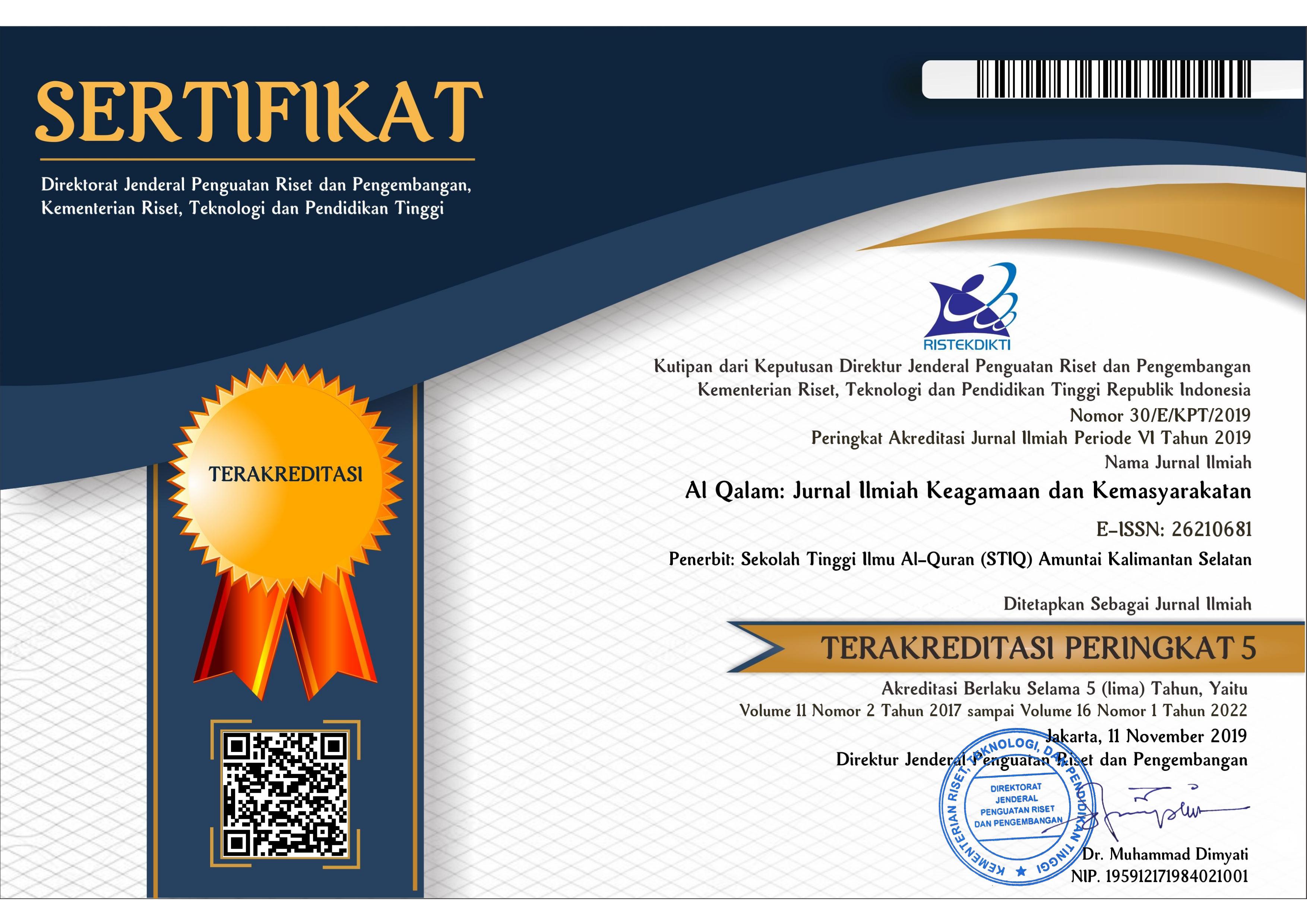
Al Qalam: Jurnal Ilmiah Keagamaan dan Kemasyarakatan
index by:




Publish by:
Sekolah Tinggi Ilmu Al-Qur'an Amuntai
Contact us:
Address: Jl. Rakha Pakapuran, Amuntai Utara
Kabupaten : Hulu Sungai Utara
Kode Pos : 71471
Provinsi : Kalimantan Selatan
Telephone : 085251613000
Email: hafizhihusinsungkar@gmail.com

This work is licensed under a Creative Commons Attribution 4.0 International License