


Halal Tourism from the Perspective of the Quran: An Exploration of the Meaning of Riḥlah According to Ash-Shaʻrāwī and Its Implications for Muslim Travel Ethics
Abstract
The growing trend of Muslim travel to various global destinations necessitates the concept of halal tourism, which prioritises not only the fulfilment of Islamic law but also Islamic ethical and spiritual values. However, the implementation of halal tourism has tended to be reductive, focusing primarily on halal food and prayer facilities, without exploring more substantive Quranic dimensions. This study aims to explore the meaning of riḥlah in the Quran based on Ash-Shaʻrāwī’s interpretation and examine its implications for contemporary Muslim travel ethics. Using a qualitative method with a thematic approach and analysis of Ash-Shaʻrāwī’s thematic interpretations, data were collected from tafsir books, supporting literature, and secondary sources on halal tourism. The results show that riḥlah, from the Ash-Shaʻrāwī perspective, is not merely a physical activity of moving from one place to another, but a spiritual and epistemological process of knowing God through His signs in nature. Riḥlah also has social, economic, and educational functions, emphasising morality, responsibility, and self-reflection. In the context of halal tourism, these values form the basis for establishing a responsible, environmentally conscious, and respectful Muslim travel ethic.
Keywords
Full Text:
PDFReferences
Akyol, M., and O. Kilinc. “Internet and Halal Tourism Marketing.” Turkish Studies 9 (2014): 171–86. https://doi.org/10.7827/TurkishStudies.7278.
Al-‘Asqalānī, Aḥmad bin ‘Alī bin Ḥajar. Fatḥ Al-Bārī. Mesir: al-Maktabah al-Salafiyyah, 1970.
Al-Asfahānī, Al-Rāghib. Mu’jam Mufradāt Alfāẓ Alquran. Damsik: Dār al-Qalam, 2009.
Al-Bāqī, Muḥammad Fuād ‘Abd. Al-Mu‘Jam Al-Mufahras Li Alfāẓ Al-Qur’Ān Al-Karīm. Kairo: Dār al-Kutub al-Miṣriyyah, 1945.
Al-Qurṭubī, Abū ‘Abdillāh Muḥammad bin Aḥmad al-Anṣārī. Al-Jāmi’ Li Aḥkām Al-Qur’ān. Edited by Aḥmad Al-Birdūnī and Ibrāhīm Aṭfīsy. Kairo: Dār al-Kutb al-Miṣriyyah, 1964.
Al-Qusyayrī, ʻAbd al-Karīm bin ʻAbd al-Mulk. Al-Risālah Al-Qusyayriyyah. Edited by A. Hanafi. Kairo: Dār al-Maʻārif, 1998.
Al-Rāzī, Abū ‘Abdillah Muḥammad bin ‘Amr bin al-Ḥasan bin al-Ḥusain al-Tamīmī. Mafātiḥ Al-Gaib. Beirūt: Dār Iḥyā’ al-Turāṡ al-Arābī, 2001.
Al-Ṭabarī, Abū Ja’far Muḥammad bin Jarīr. Jāmi’ Al-Bayān ‘an Ta’Wīl Ai Al-Qur’ān. Kairo: Dār al-Ḥijr, 2001.
Al-Żahabī, Syamsuddīn Muḥammad bin Aḥmad bin ‘Uṡmān. Siyar A’lām Al-Nubalā’. Kairo: Dār al-Ḥadīṡ, 1985.
Aṣ-Ṣa’īdī, ʻAbdul Ḥakam. Al-Riḥlah Fī Al-Islām. Riyad: Maktabah Dār al-ʻArabiyyah, 1996.
Asy-Sya’rāwī, Muḥammad Mutawallī. Tafsīr Asy-Sya’rāwī. Madinah: Akhbār al-Yaum, 1997.
Battour, Mohamed, and Mohd. Nazari Ismail. Halal Tourism. London: Routledge, 2018.
Bustamam, Nawarti, and Susie Suryani. “Potensi Pengembangan Pariwisata Halal Dan Dampaknya Terhadap Pembangunan Ekonomi Daerah Provinsi Riau.” Jurnal Ekonomi KIAT 32, no. 2 (2022): 146–62. https://doi.org/10.25299/kiat.2021.vol32(2).8839.
Duman, Teoman. “The Value of Islamic Tourism: Perspectives from the Turkish Experience.” ICR Journal 3, no. 4 (July 15, 2012): 718–39. https://doi.org/10.52282/icr.v3i4.513.
Fauzi, Muhammad Ashraf, and Mohamed Battour. “Halal and Islamic Tourism: Science Mapping of Present and Future Trends.” Tourism Review 80, no. 5 (2024): 1156–1170. https://doi.org/10.1108/TR-08-2023-0533.
Febriyanti, Novi. “The Review of Islamic Law on the Distribution of Zakat Directly by Muzaki to Mustahik in the Sunan Ampel Religious Tourism Area in Surabaya.” Vol. 11, 2020.
Hamim, Khairul. “Travel in Islam (A Study of the Concept of Sīrū in the Qur’an).” Ulumuna 27, no. 2 (December 11, 2023): 529–51. https://doi.org/10.20414/ujis.v27i2.785.
Hamzana, Adrian Adi. “Pelaksanaan Standarisasi Pelayanan Pariwisata Halal Dalam Pengembangan Pariwisata Di Nusa Tenggara Barat.” Pena Justisia 17, no. 2 (2017): 1–16. https://doi.org/10.31941/PJ.V17I2.545.
Henderson, Joan C. “Halal Food, Certification and Halal Tourism: Insights from Malaysia and Singapore.” Tourism Management Perspectives 19 (2016): 160–64. https://doi.org/10.1016/j.tmp.2015.12.006.
Huda, Bakhrul. “Konsep Wisata Halal Dan Hak-Hak Wisatawan Dalam Perspektif Fikih (The Concept of Halal Tourism and the Tourist Rights in an Islamic Jurisprudence ….” El-Qist: Juounal of Islamic Economics and Business (JIEB) 12, no. 1 (2022): 57–76. http://jurnalfebi.uinsby.ac.id/index.php/elqist/article/download/818/372.
Jaenudin, Jaenudin. “Pendidikan Pariwisata Dalam Al-Qur’an: Telaah Ayat-Ayat Yang Berkaitan Dengan Pariwisata.” Andragogi: Jurnal Pendidikan Islam Dan Manajemen Pendidikan Islam 3, no. 1 (2021): 73–93. https://doi.org/10.36671/andragogi.v4i01.154.
Mahardini, Indah murni. “Wisata Religi Menurut Al-Qur’an: Kajian Penafsiran Quraish Shihab.” Journal of Islamic Scriptures in Non-Arabic Societies 8, no. 3 (2022). https://www.researchgate.net/publication/378446072_Wisata_Religi_Menurut_al-Qur’an_Kajian_Penafsiran_Quraish_Shihab.
Mohsin, Asad, Noriah Ramli, and Bader Abdulaziz Alkhulayfi. “Halal Tourism: Emerging Opportunities.” Tourism Management Perspectives 19 (2016): 137–43. https://doi.org/10.1016/j.tmp.2015.12.010.
Mukidi. “Prosedur Pemberian Sertifikat Label Halal Terhadap Produk Makanan Di Restoran Hotel Syariah Untuk Mewujudkan Hak Kenyamanan Konsumen Muslim.” Jurnal Hukum Kaidah 19, no. 3 (2020): 397–415. https://doi.org/10.30743/JHK.V19I3.2674.
Najib, Jauhar, Akhmad Sulthoni, Muhammad Mukharom Ridho, Sekolah Tinggi, and Ilmu Al- Qur. “Traveling Dalam Al-Qur’an: Studi Penafsiran Ayat-Ayat Riḥlah Dan Safar Dalam Tafsir Al-Azhar.” Journal of Islamic Scriptures in Non-Arabic Societies 1, no. 3 (2024): 191–207. https://doi.org/10.51214/jisnas.v1i3.1032.
Pappalardo, Luca, Ed Manley, Vedran Sekara, and Laura Alessandretti. “Future Directions in Human Mobility Science.” Nature Computational Science 3, no. 7 (2023): 588–600. https://doi.org/10.1038/s43588-023-00469-4.
Rachman, Abdul, and Bilaly Sangare. “Impact of Implementation of Halal Tourism in West Nusa Tenggara Province: Maqashid Al-Sharia Perspective.” Justicia Islamica 20, no. 1 (June 20, 2023): 17–36. https://doi.org/10.21154/justicia.v20i1.5173.
Tuncer, Faruk. “The Terms Trade (Tijarah) and Road (Rihlah) in Qur’anic Context: With Special References to the Trade of Prophet Muhammad in Sirah.” Religions 14, no. 8 (2023): 1055. https://doi.org/10.3390/rel14081055.
Yuliaty, Tetty. “Model Wisata Halal Sustainable Di Indonesia.” Universitas Islam Negeri Sumatera Utara Medan, 2020.
Zailani, Suhaiza, Azizah Omar, and Simon Kopong. “An Exploratory Study on the Factors Influencing the Non-Compliance to Halal among Hoteliers in Malaysia.” International Business Management 5, no. 1 (2011): 1–12. https://doi.org/10.3923/ibm.2011.1.12.
Zakariyā, Abū Ḥusain Aḥmad bin Farīs bin. Mu’jam Maqāyis Al-Lugah. Beirūt: Dār al-Fikr, 1979.
Zamani-Farahani, Hamira, and Joan C. Henderson. “Islamic Tourism and Managing Tourism Development in Islamic Societies: The Cases of Iran and Saudi Arabia.” International Journal of Tourism Research 12, no. 1 (2010): 79–89. https://doi.org/10.1002/jtr.741.
DOI: http://dx.doi.org/10.35931/aq.v20i1.5477
Refbacks
- There are currently no refbacks.
Copyright (c) 2025 Muhammad Fakih Hasibuan, Sukiman Sukiman, Muhammad Roihan Nasution

This work is licensed under a Creative Commons Attribution 4.0 International License.
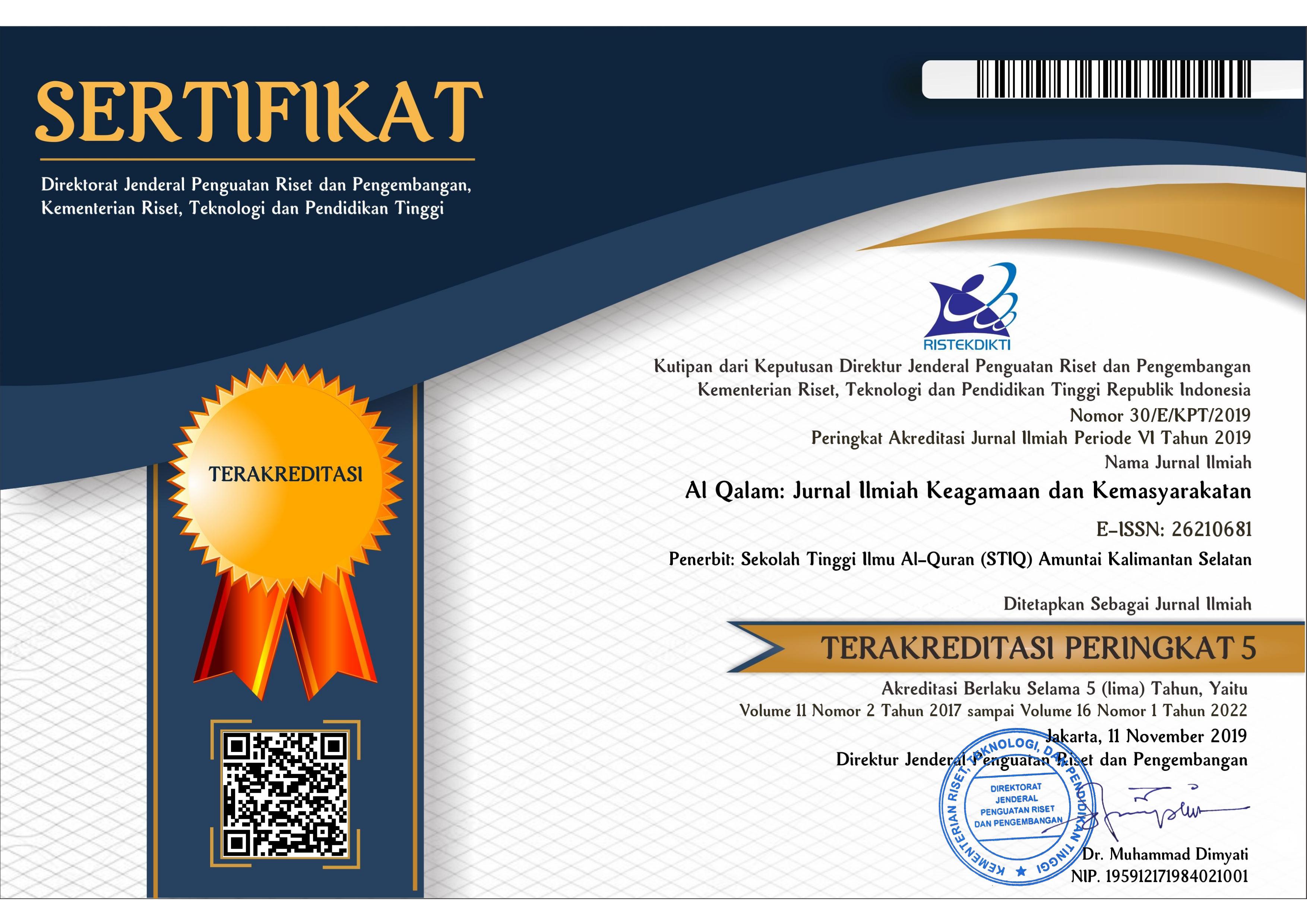
Al Qalam: Jurnal Ilmiah Keagamaan dan Kemasyarakatan
index by:












Publish by:
Sekolah Tinggi Ilmu Al-Qur'an Amuntai
Contact us:
Address: Jl. Rakha Pakapuran, Amuntai Utara
Kabupaten : Hulu Sungai Utara
Kode Pos : 71471
Provinsi : Kalimantan Selatan
Telephone : 085251613000
Email: hafizhihusinsungkar@gmail.com

This work is licensed under a Creative Commons Attribution 4.0 International License