



Basic Concepts of Learning Evaluation in the Perspective of the Qur'an and Hadith
Abstract
This study aims to explore in depth the fundamental concept of evaluation from the perspective of the Qur'an and Hadith, focusing on three main aspects: the definition of learning evaluation in the Qur'an and Hadith, the objectives of learning evaluation in the Qur'an and Hadith, and the principles of learning evaluation derived from these two primary foundations of Islamic teachings. The background of this study stems from the awareness that the evaluation process in education is not merely intended to assess students' learning achievements but also serves as a means of nurturing moral character and strengthening spiritual values in accordance with Islamic law. Therefore, a comprehensive understanding is required of how learning evaluation is positioned within the framework of the values of the Qur'an and Hadith, so that its implementation is not only technical in nature but also embodies moral and spiritual dimensions. This study employs a qualitative approach using a library research method, which involves reviewing, examining, and analyzing data from various relevant primary and secondary literature sources, including Qur'anic exegesis, Hadith commentaries, and scholarly books on Islamic education. The results of the study indicate that learning evaluation from the perspective of the Qur'an and Hadith is not solely oriented toward cognitive learning outcomes but also encompasses affective and psychomotor aspects, emphasizing the formation of Islamic character, honesty, responsibility, and diligence in learning.
Keywords
Full Text:
PDFReferences
Arikunto, Suharsini. Basics of Educational Evaluation. Jakarta: Bumi Aksara, 2007.
Bulu', and Muhaemin. Islamic Education. South Sulawesi: Read Institute Press, 2014.
Devi, Aulia Diana, and Seka Andrean. “The Concept of Islamic Education Evaluation from the Perspective of the Qur'an and Its Implications.” Journal for Islamic Studies: Al-Afkar 4, no. 1 (2021): 42–52. https://al-afkar.com/index.php/Afkar_Journal/issue/view/4https://al-fkar.com/index.php/Afkar_Journal/issue/view/4.
Idris, Muhammad. “Implementation of the BTAQ (Al-Quran Reading and Writing) Program in Improving Students' Al-Quran Reading and Writing Skills at State Islamic Senior High School (MAN) 2 Sleman Yogyakarta.” Islamic University of Indonesia Yogyakarta, 2020.
Indonesia, Ministry of Religious Affairs of the Republic of Indonesia. Al-Quran Aliyah Mushaf and Translation and Interpretation for Women. Jakarta: Qalam, 2020.
Marzuki, Ismail. "Implementation of Learning Evaluation Principles in Islamic Religious Education Subjects." Tadarus Tarbawy: Journal of Islamic Studies and Education 6, no. 1 (2024): 91–97. https://doi.org/10.31000/jkip.v6i1.11821.
Nashar Zulfa, Alya. “Implementation of the Quran Reading and Writing Program to Improve the Quran Reading and Writing Skills of Students at Pujon State Junior High School.” Maulana Malik Ibrahim State Islamic University of Malang, 2020.
Nasution, Suryadi. Tafsir Tarbawi: Tracing the Construction of Education in the Quran and Hadith. Mandailing Natal: Madina Publisher, 2022.
Nasution, Zulkipli. "Evaluation of Al-Quran Hadith Learning in Madrasas." Journal of Education and Islam V, no. 1 (2022): 129–43.
Nata, Abudin. Educational Management: Overcoming the Weaknesses of Islamic Education in Indonesia. Jakarta: Prenada Media Group, 2008.
Rahayu, Fitriani. “The Substance of Educational Evaluation from the Perspective of Islamic Education.” AL-ISHLAH: Journal of Islamic Education 17, no. 2 (2019): 103–22. https://doi.org/10.35905/alishlah.v17i2.1000.
Sahlan, Moh. Learning Evaluation: Practical Guide for Educators and Prospective Educators. Mangli: STAIN Jember PRESS, 2013.
Sari, Kartika. “Implementation of the Smart Al Quran Program to Create a Culture of Enthusiasm for Reading the Quran among Students at Brawijaya Smart School Junior High School, Malang.” Maulana Malik Ibrahim State Islamic University, Malang, 2020.
Sari, Lia Mega. “Evaluation in Islamic Education.” Al-Tadzkiyyah: Journal of Islamic Education 9, no. 2 (2019): 211. https://doi.org/10.24042/atjpi.v9i2.3624.
Solihin, Muhammad. “Evaluation of Islamic Education in the Qur'an and Hadith.” Journal of Education, Teaching, and Learning 2, no. 1 (2025): 214–25.
Subur. “Materials, Methods, and Evaluation of Learning from the Perspective of the Qur'an (Psychological Approach).” Ministry of Health of the Republic of Indonesia 2, no. 2 (2018): 19.
Supatmi, and Meti Fatimah. “Educational Evaluation from the Perspective of the Quran.” Nusantara Educational Innovation 6, no. 2 (2025): 188–96.
Susanti, Cela Petty, and Aliyah Rahmatiyah. “The Urgency of Evaluating Islamic Education from the Perspective of the Qur'an in Madrasahs.” Auladuna: Journal of Elementary Madrasah Teacher Education Study Program 4, no. 2 (2022): 125–43. https://doi.org/10.36835/au.v4i2.1113.
Syaifullizani, Syaifuddin Sabda, Ridhahani Fidzi, and Husnul Yaqin. “Evaluation of Multi, Inter, and Transdisciplinary Islamic Education from the Perspective of the Qur'an with a Theoretical Approach” 4, no. 2 (2025): 3080–86. https://publisherqu.com/index.php/pediaqu/article/view/2033.
Wahyudi, Dedi. “The Qur'anic Conception of the Nature of Evaluation in Islamic Education.” HIKMAH Journal of Islamic Studies XII, no. 2 (2016): 245–72.
DOI: http://dx.doi.org/10.35931/aq.v20i1.5631
Refbacks
- There are currently no refbacks.
Copyright (c) 2025 Jihan In Fatiha, Ainur Rafik, Abd Muhith

This work is licensed under a Creative Commons Attribution 4.0 International License.
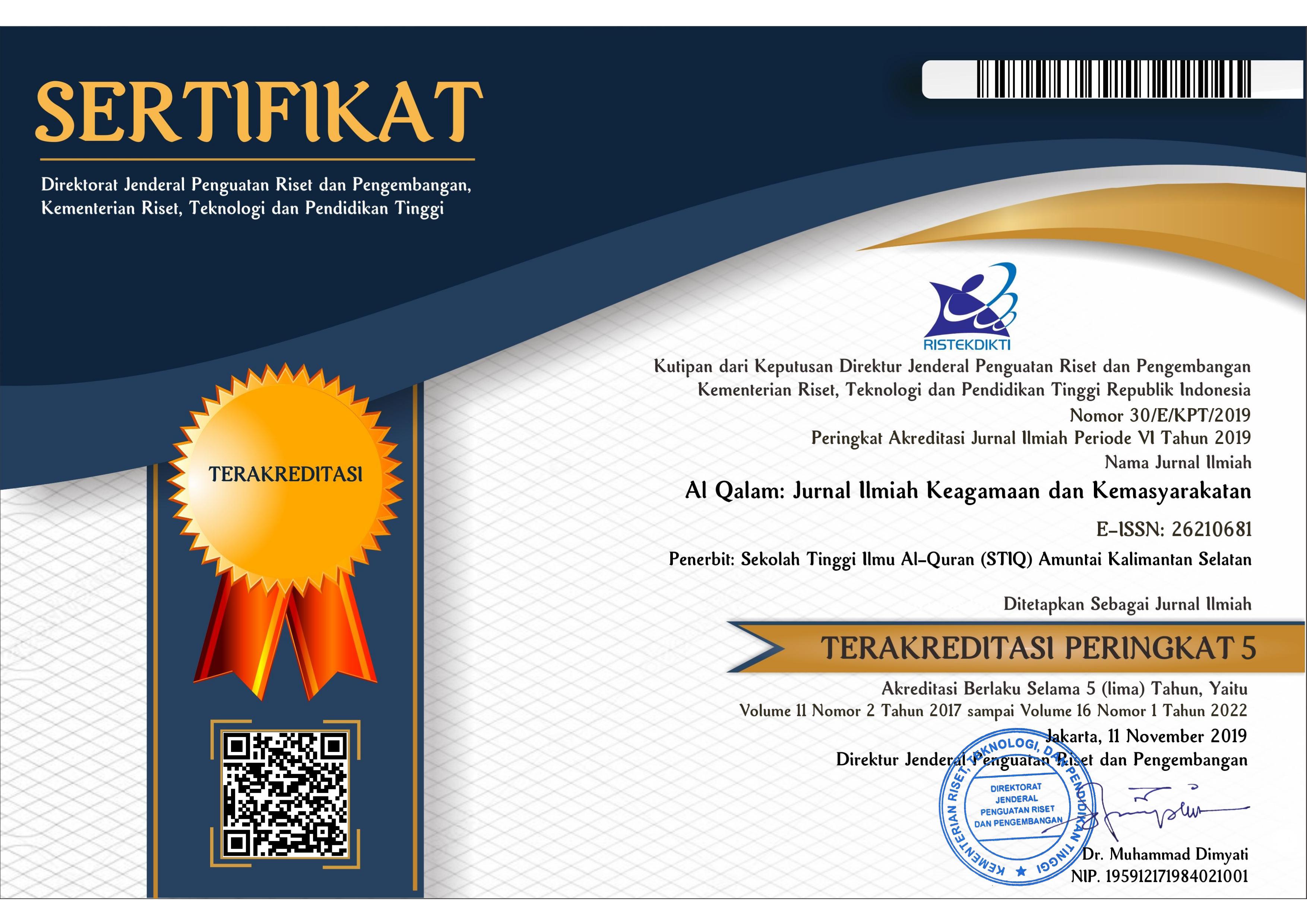
Al Qalam: Jurnal Ilmiah Keagamaan dan Kemasyarakatan
index by:











Publish by:
Sekolah Tinggi Ilmu Al-Qur'an Amuntai
Contact us:
Address: Jl. Rakha Pakapuran, Amuntai Utara
Kabupaten : Hulu Sungai Utara
Kode Pos : 71471
Provinsi : Kalimantan Selatan
Telephone : 085251613000
Email: hafizhihusinsungkar@gmail.com

This work is licensed under a Creative Commons Attribution 4.0 International License