



Integration of Factor Analysis and Fiqh Muamalah to Entrepreneurial Behavior
Abstract
The development of modern entrepreneurship often focuses on economic efficiency, while the ethical dimensions of sharia-based principles remain underexplored empirically. This study places this issue within the context of Islamic jurisprudence (fiqh muamalah), specifically the principles of buying and selling that emphasize justice, trustworthiness, and the prohibition of gharar, as the basis of Islamic business ethics. The purpose of this study is to integrate a multivariate factor analysis approach with the principles of Islamic jurisprudence (fiqh muamalah) to develop a model of ethical entrepreneurial behavior in the Islamic trade system. The methods used include a survey of Muslim business actors in the trade and small industry sectors, followed by exploratory factor analysis (EFA) to identify the latent structure of sharia values, as well as confirmatory factor analysis (CFA) and structural equation modeling (SEM) to test the causal relationship between compliance with muamalah, ethical orientation, and business sustainability. The results of the study indicate that the latent variables "transaction fairness" and "business trustworthiness" have a dominant contribution to the formation of ethical entrepreneurial behavior, while the factor "prohibition of gharar and usury" functions as a moral controller in business decision-making. The conclusion of this study explains in detail the integration of the principles of muamalah fiqh in multivariate factor analysis strengthening the theoretical validity of Islamic entrepreneurship and providing a quantitative basis where transaction justice r = 0.68; business trustworthiness r = 0.63; prohibition of gharar and usury r = 0.59; blessing orientation r = 0.74.
Keywords
Full Text:
PDFReferences
Abdullah, R., and F. Rahman. “Islamic Entrepreneurial Ethics and Business Sustainability in Southeast Asia.” Journal of Islamic Business and Management 11, no. 2 (2021): 85–101. https://doi.org/10.26501/jibm.v11i2.210.
Ahmad, N., and Z. Arifin. “Integrating Maqasid Al-Shariah into Entrepreneurial Decision-Making: A Conceptual Framework.” International Journal of Islamic Economics and Finance Studies 6, no. 1 (2020): 45–62. https://doi.org/10.25272/ijisef.2020.6.1.04.
Almubarak, Z., and A. Al-Kandari. “The Role of Islamic Ethics in Shaping Moral Entrepreneurship Behavior: Empirical Evidence from GCC Countries.” Journal of Business Ethics 179, no. 4 (2022): 975–90. https://doi.org/10.1007/s10551-021-04961-5.
Cichocka, A. “Understanding Defensive and Secure In-Group Positivity: The Role of Collective Narcissism.” European Review of Social Psychology 27, no. 1 (2016): 283–317. https://doi.org/10.1080/10463283.2016.1252530.
Hidayat, R., and A. Khalika. “Implementasi Nilai-Nilai Fiqih Muamalah Dalam Sistem Ekonomi Islam Di Indonesia.” Jurnal Ekonomi Dan Keuangan Islam 5, no. 2 (2019): 99–112. https://doi.org/10.20885/JEKI.vol5.iss2.art3.
Ikhwan, M. “Fiqh Muamalah Sebagai Etika Sosial-Ekonomi Dalam Islam Modern.” Al-Iqtishad: Journal of Islamic Economics 11, no. 1 (2019): 33–50. https://doi.org/10.15408/aiq.v11i1.10912.
Ismail, A., and S. Rahmah. “Multivariate Analysis in Modeling Islamic Entrepreneurial Behavior.” Asian Journal of Entrepreneurship Research 9, no. 3 (2023): 147–62. https://doi.org/10.14456/ajer.2023.12.
Kamba, M. “Moralitas Ekonomi Islam Dalam Dinamika Globalisasi Pasar.” Jurnal Fiqh Dan Muamalah 10, no. 2 (2018): 45–57.
Kasim, S., and N. Hasan. “Structural Equation Modeling of Ethical Entrepreneurship in Islamic Microfinance Institutions.” International Journal of Ethics and Systems 38, no. 1 (2022): 150–67. https://doi.org/10.1108/IJOES-03-2021-0071.
Madjid, N. Islam, Kemodernan, Dan Keindonesiaan. Paramadina, 2002.
Marchlewska, M., A. Cichocka, and M. Kossowska. “Addicted to Answers: Need for Cognitive Closure and the Endorsement of Conspiracy Beliefs.” Political Psychology 40, no. 1 (2019): 59–76. https://doi.org/10.1111/pops.12505.
Miller, J. D., and R. A. Josephs. “The Hierarchical Model of Achievement Motivation in Business Settings.” Journal of Applied Psychology 94, no. 1 (2009): 12–24. https://doi.org/10.1037/a0013303.
Rakhmat, J. Psikologi Komunikasi. Remaja Rosdakarya, 1989.
Sulaiman, T., and M. Noor. “Fiqh-Based Model of Business Transparency in Islamic Commerce.” Arabian Journal of Business and Management Review 14, no. 1 (2024): 33–49. https://doi.org/10.4172/2223-5833.1000456.
Tariq, M., and R. Iqbal. “Ethical Decision-Making in Islamic Entrepreneurship: A Multivariate Perspective.” Journal of Moral Economics 7, no. 1 (2023): 54–70. https://doi.org/10.1163/jome.2023.007.
DOI: http://dx.doi.org/10.35931/aq.v20i4.6206
Refbacks
- There are currently no refbacks.
Copyright (c) 2026 Andre Yuberta, Ganefri, Ambiyar, Yulastri Asmar, Yuliana, Fadhilah

This work is licensed under a Creative Commons Attribution 4.0 International License.
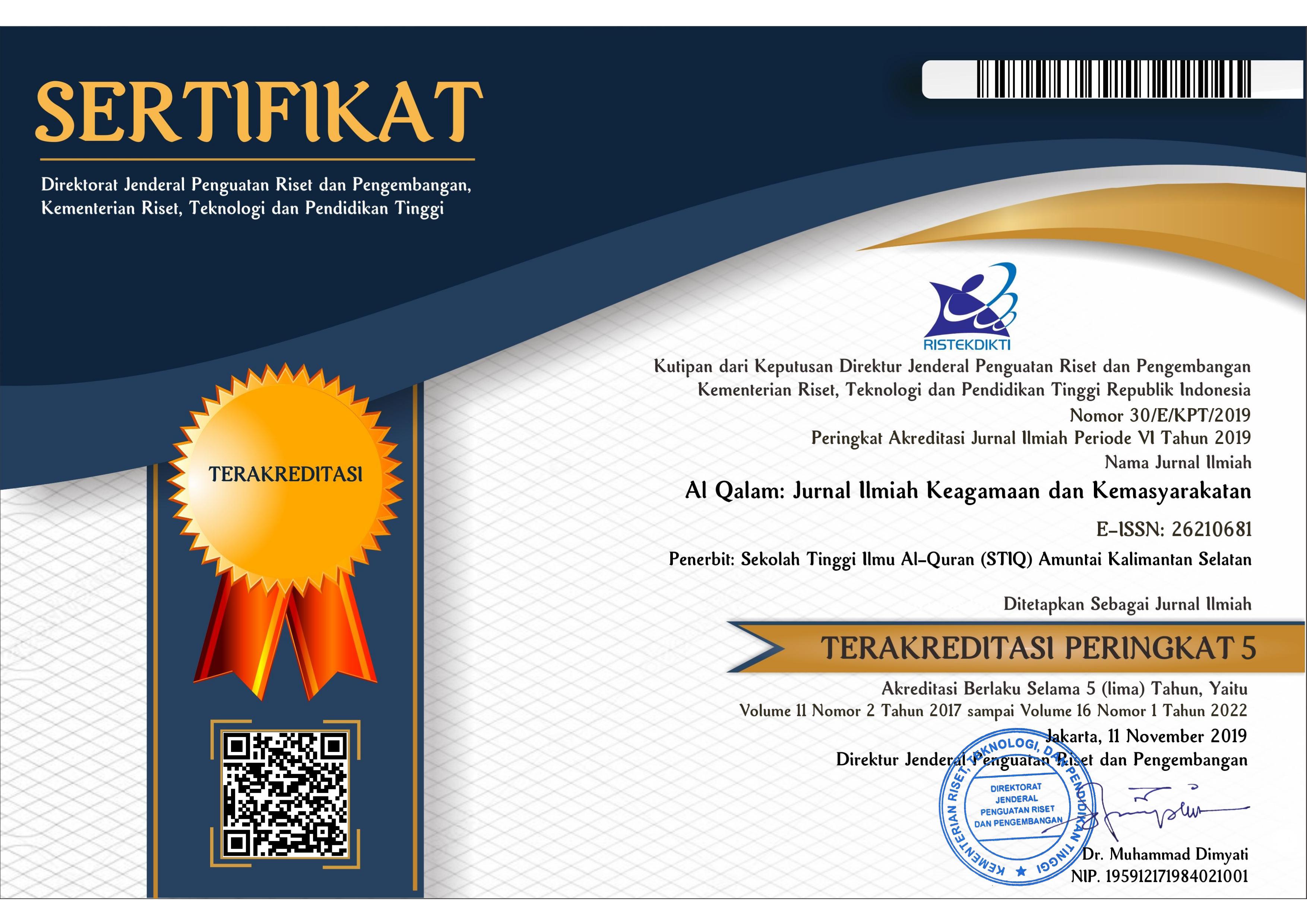
Al Qalam: Jurnal Ilmiah Keagamaan dan Kemasyarakatan
index by:












Publish by:
Sekolah Tinggi Ilmu Al-Qur'an Amuntai
Contact us:
Address: Jl. Rakha Pakapuran, Amuntai Utara
Kabupaten : Hulu Sungai Utara
Kode Pos : 71471
Provinsi : Kalimantan Selatan
Telephone : 085251613000
Email: hafizhihusinsungkar@gmail.com

This work is licensed under a Creative Commons Attribution 4.0 International License