



The Influence of School Climate on Student Engagement Moderated by Peer Support in Students of MTs Islamiyah Guppi
Abstract
This study aims to analyze the effect of school climate on student engagement with peer support as a moderator variable in students of MTs Islamiyah Guppi. The background of this study is based on the importance of a positive school environment and peer support in increasing student engagement in learning activities. The research subjects were 269 students in grades VII, VIII, and IX with an age range of 13–15 years. This study used a quantitative approach with the Partial Least Square (PLS) analysis method. The research instruments included scales of school climate, peer support, and student engagement that had been tested for validity and reliability. Based on the results of the hypothesis test, it was found that school climate had a positive and significant effect on student engagement with a coefficient value of 0.475 and a p-value of 0.000. In addition, peer support also had a positive and significant effect on student engagement with a coefficient value of 0.475 and a p-value of 0.000. The results of the moderation test showed that peer support significantly moderated the relationship between school climate and student engagement, with a coefficient value of 0.131 and a p-value of 0.024. The total effect value of 0.606 indicates that the more positive the school climate and the stronger the peer support, the higher the level of student engagement in learning activities. This finding confirms that student engagement in school is influenced not only by a conducive school climate but also by social support among students, which strengthens these positive relationships.
Keywords
Full Text:
PDFReferences
Alaei, Mohammad Mahdi, and H. Hosseinnezhad. “The Development and Validation of Peer Support Questionnaire (PSQ).” Journal of Teaching Language Skills 39, no. 3.2 (2021): 67–109.
Allen, Kelly, Margaret L. Kern, Dianne Vella-Brodrick, John Hattie, and Lea Waters. “What Schools Need to Know About Fostering School Belonging: A Meta-Analysis.” Educational Psychology Review 30 (2018): 1–34.
Appleton, James J., Sandra L. Christenson, and Michael J. Furlong. “Student Engagement with School: Critical Conceptual and Methodological Issues of the Construct.” Psychology in the Schools 45, no. 5 (2008): 369–86.
Appleton, James J., Sandra L. Christenson, Dongjin Kim, and Amy L. Reschly. “Measuring Cognitive and Psychological Engagement: Validation of the Student Engagement Instrument.” Journal of School Psychology 44, no. 5 (2006): 427–45. https://doi.org/10.1016/j.jsp.2006.04.002.
Azwar, Saifuddin. Penyusunan Skala Psikologi. Pustaka Pelajar, 2010.
Block, Martin. “School Climate.” In Encyclopedia of Child Behavior and Development. Springer US, 2011. https://doi.org/10.1007/978-0-387-79061-9_2500.
Cohen, Jonathan, Elizabeth M. McCabe, Nicholas M. Michelli, and Terry Pickeral. “School Climate: Research, Policy, Practice, and Teacher Education.” Teachers College Record 111, no. 1 (2009): 180–213.
Dennis, Cindy-Lee. “Peer Support Within a Health Care Context: A Concept Analysis.” International Journal of Nursing Studies 40, no. 3 (2003): 321–32.
Dharmayana, I. Wayan, Amitya Kumara, and Y. G. Wirawan. “Keterlibatan Siswa (Student Engagement) Sebagai Mediator Kompetensi Emosi Dan Prestasi Akademik.” Jurnal Psikologi 39, no. 1 (2012): 76–94.
Esposito, Christopher. “Learning in Urban Blights: School Climate and Its Effect on the School Performance of Urban, Minority, Low-Income Children.” School Psychology Review 28, no. 3 (1999): 365–77.
Fredricks, Jennifer A., Phyllis C. Blumenfeld, and Alison H. Paris. “School Engagement: Potential of the Concept, State of the Evidence.” Review of Educational Research 74, no. 1 (2004): 59–109.
Haryadi, F., and Y. Sutopo. “Hubungan Antara Dukungan Iklim Sekolah, Dukungan Iklim Keluarga, Pengaruh Teman Sebaya Dengan Perundungan Antar Siswa Sekolah Menengah Pertama: Peran Mediasi Variabel Kesejahteraan Psikologis.” Pendas: Jurnal Ilmiah Pendidikan Dasar 10, no. 03 (2025): 250–62.
Huwae, A., and M. P. Novita. “Regulasi Diri, Peer Support, Dan Burnout Pada Mahasiswa Difabel.” Psychocentrum Review 4, no. 1 (2022): 44–54.
Mahardika, A. A., and A. Nurkhin. “Pengaruh Peer Support, Teacher Support, Dan Digital Literacy Terhadap Student Engagement Dengan Self Regulated Learning Sebagai Pemediasi.” Journal of Accounting, Economics, and Business Education, 2024, 178–95.
Muhibbin, M. A., and J. F. U. Yusri. “Pengaruh Dukungan Keluarga Dan Iklim Sekolah Terhadap Student Engagement Siswa Sekolah Menengah.” Jurnal Pendidikan Indonesia: Teori, Penelitian, Dan Inovasi 5, no. 3 (2025).
DOI: http://dx.doi.org/10.35931/aq.v20i4.6867
Refbacks
- There are currently no refbacks.
Copyright (c) 2026 Fuad Hasan Daulay, Siti Aisyah, Salamiah Sari Dewi

This work is licensed under a Creative Commons Attribution 4.0 International License.
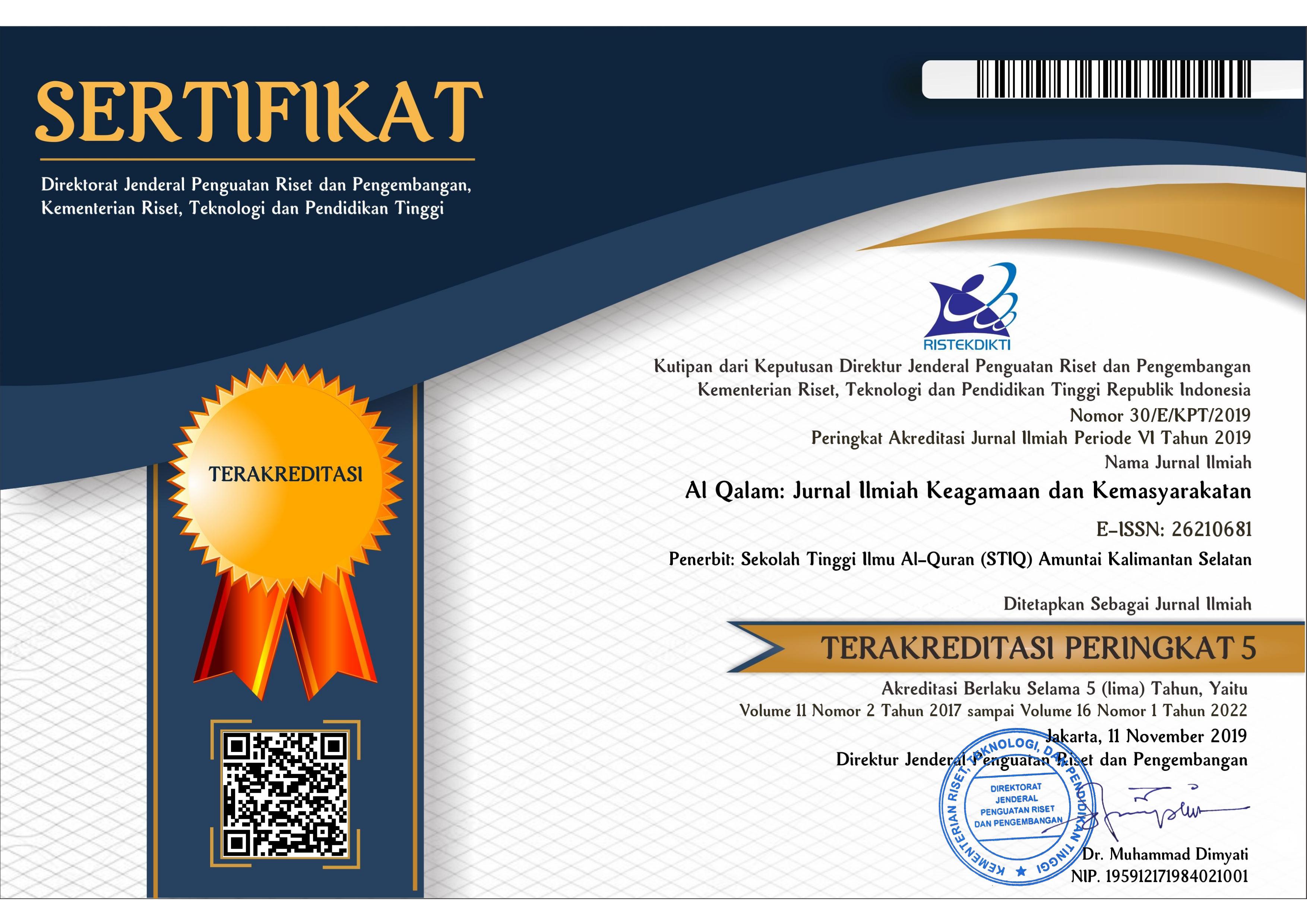
Al Qalam: Jurnal Ilmiah Keagamaan dan Kemasyarakatan
index by:












Publish by:
Sekolah Tinggi Ilmu Al-Qur'an Amuntai
Contact us:
Address: Jl. Rakha Pakapuran, Amuntai Utara
Kabupaten : Hulu Sungai Utara
Kode Pos : 71471
Provinsi : Kalimantan Selatan
Telephone : 085251613000
Email: hafizhihusinsungkar@gmail.com

This work is licensed under a Creative Commons Attribution 4.0 International License