


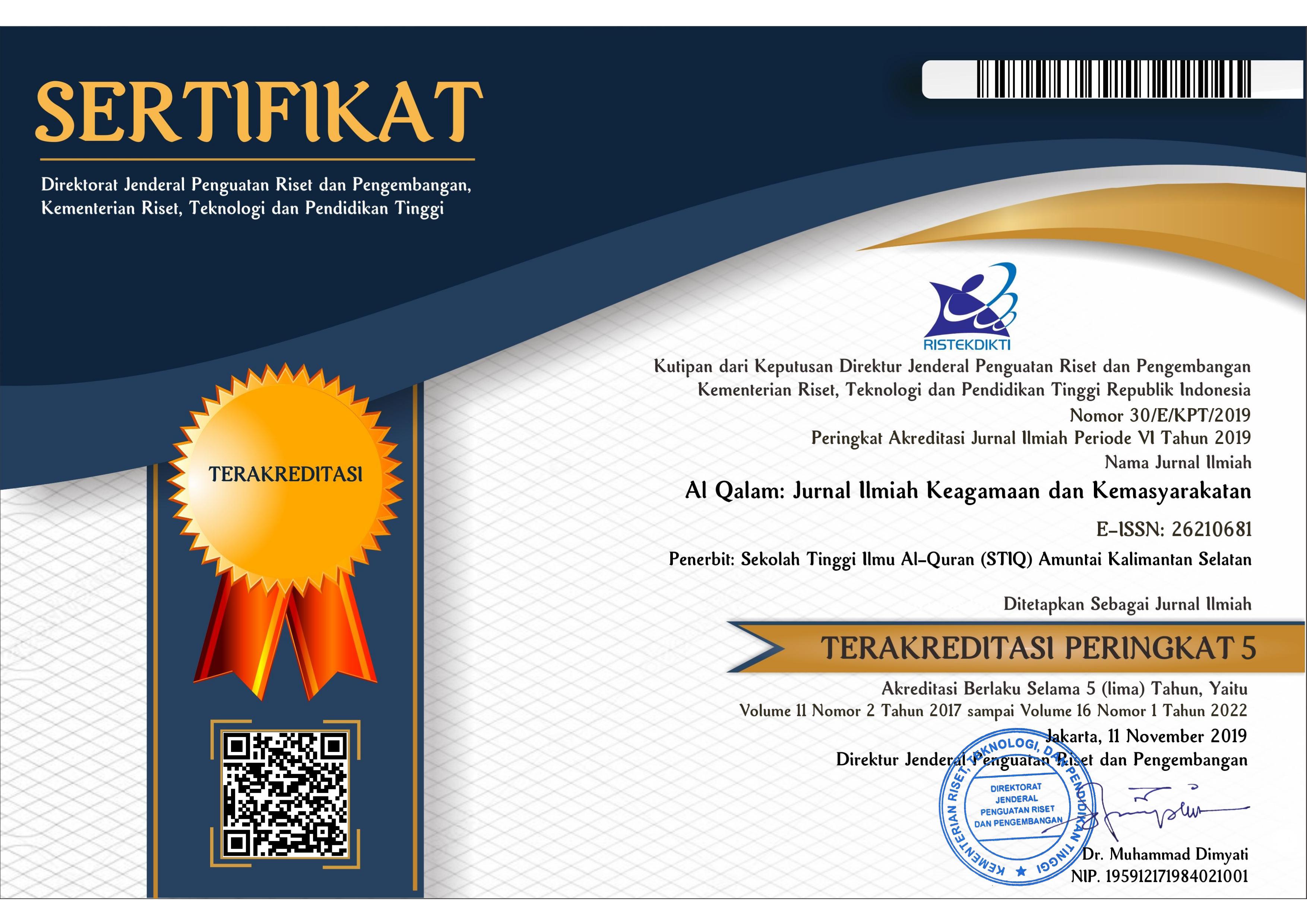
Al Qalam: Jurnal Ilmiah Keagamaan dan Kemasyarakatan, published by Sekolah Tinggi Ilmu Al-Qur'an Amuntai (STIQ Amuntai), is committed to maintaining the accuracy, reliability, transparency, and integrity of the scholarly record. The journal recognizes that errors or ethical concerns may be identified after publication and that appropriate editorial action is necessary to ensure the credibility of published research.
In accordance with the guidelines established by the Committee on Publication Ethics (COPE), the journal implements procedures for addressing post-publication errors, issuing corrections, publishing expressions of concern, and retracting articles when necessary. These procedures are intended to protect the integrity of scholarly literature while ensuring fairness, accountability, and transparency for authors, readers, and the academic community.
1. Corrections (Erratum and Corrigendum)
The journal may issue a formal correction when errors are identified in a published article but do not substantially compromise the reliability of its research findings or overall conclusions. Corrections are intended to maintain the accuracy of the scholarly record without unnecessarily withdrawing otherwise valid research.
Corrections may be classified into two categories:
-
Erratum: A correction issued to address errors introduced during the editorial or production process, such as incorrect formatting, publication metadata, typographical mistakes, or other production-related inaccuracies.
-
Corrigendum: A correction issued to address errors originating from the authors, including inaccuracies in data presentation, references, figures, tables, or other elements that require clarification without invalidating the principal research findings.
All substantive corrections will be evaluated by the editorial team to determine their significance and appropriate treatment. When a formal correction is necessary, the journal will publish a clearly identified correction notice linked to the original article. Corrections must be transparent and should not obscure the original publication history.
2. Retraction of Published Articles
The journal may retract a published article when substantial evidence indicates that its findings, content, or publication process are seriously compromised. Retraction is intended to correct the scholarly record and inform readers that the affected publication should no longer be considered a reliable source of scientific evidence.
Articles may be considered for retraction under the following circumstances:
-
Research Misconduct: Confirmed or sufficiently substantiated fabrication, falsification, serious plagiarism, inappropriate image manipulation, or other practices that undermine the reliability of the research.
-
Unreliable Research Findings: Major methodological errors, substantial inaccuracies, or invalid data that significantly affect the article's findings or conclusions, whether resulting from misconduct or honest error.
-
Duplicate or Redundant Publication: Substantial republication of previously published material without appropriate acknowledgment, authorization, or legitimate justification.
-
Serious Ethical Violations: Significant breaches of research ethics, unauthorized use of confidential information or copyrighted materials, or other ethical violations affecting the legitimacy of the publication.
-
Compromised Publication Process: Manipulated peer review, fraudulent authorship, or undisclosed conflicts of interest that substantially compromise editorial independence or the credibility of the published work.
Retraction decisions will be based on the seriousness of the identified concerns, the available evidence, and applicable COPE guidelines. Retraction is not intended as a punitive measure against authors but as a necessary mechanism for preserving the integrity of the academic record.
3. Expression of Concern
When serious concerns regarding a published article arise but the available evidence is insufficient to justify an immediate correction or retraction, the journal may publish an Expression of Concern.
An Expression of Concern may be issued when investigations are ongoing, evidence of potential research misconduct remains inconclusive, or significant questions about the reliability of published findings cannot be promptly resolved.
This notice serves to inform readers of unresolved issues while further examination is conducted. Depending on the outcome of the investigation, the Expression of Concern may subsequently be followed by a correction, retraction, or an editorial notice explaining the resolution of the concerns.
4. Editorial Investigation and Decision-Making
Concerns regarding published articles may be reported by authors, reviewers, readers, research institutions, or other relevant parties. The editorial team will conduct an initial assessment of the reported issues and determine whether further investigation is warranted.
When necessary, the journal will contact the corresponding author and other relevant contributors to request explanations, supporting documentation, original research data, or other evidence. Authors will be given an appropriate opportunity to respond to allegations before a final editorial decision is made.
For complex cases involving suspected research misconduct, the journal may seek independent expert evaluation or consult relevant research institutions and ethics committees. Investigations will be conducted fairly, confidentially where appropriate, and without unnecessary delay.
The Editor-in-Chief, or an appropriately designated independent editor where a conflict of interest exists, will make the final editorial decision based on the available evidence and applicable publication ethics standards. A retraction may be issued when justified by the evidence, even if the authors do not agree with the decision.
5. Publication and Preservation of Retraction Notices
When an article is retracted, the journal will publish a formal Retraction Notice that clearly identifies the affected publication, explains the reasons for retraction, and indicates the party responsible for issuing the notice.
The original article will ordinarily remain accessible through the journal's online archive but will be prominently marked as "RETRACTED" to prevent readers from treating its findings as valid scientific evidence. The retraction notice will be linked to the original publication, and relevant metadata will be updated where technically possible.
Retracted articles will not normally be permanently deleted from the journal's publication records, as maintaining a transparent scholarly history is essential to academic accountability. Complete removal of published content will be considered only in exceptional circumstances involving serious legal, privacy, or safety concerns.
6. Reporting Corrections and Retraction Requests
Authors, readers, and other concerned parties are encouraged to report any significant errors, ethical concerns, or suspected misconduct identified in articles published by the journal. Reports should include the article title, authors' names, DOI or publication details, a clear description of the concern, and any relevant supporting evidence.
All reports will be reviewed objectively in accordance with the journal's editorial procedures and publication ethics policies.
Editorial Contact:
Al Qalam: Jurnal Ilmiah Keagamaan dan Kemasyarakatan
Email: redaksi.alqalam10@gmail.com
Commitment to Publication Integrity
Through the implementation of this policy, Al Qalam: Jurnal Ilmiah Keagamaan dan Kemasyarakatan seeks to maintain a trustworthy scholarly record, promote responsible research practices, and ensure that published academic works remain subject to appropriate correction and ethical evaluation.
The journal refers to the COPE Retraction Guidelines and relevant international publication ethics standards when addressing corrections, expressions of concern, and retractions.
Al Qalam: Jurnal Ilmiah Keagamaan dan Kemasyarakatan
index by:








Publish by:
Sekolah Tinggi Ilmu Al-Qur'an Amuntai
Contact us:
Address: Jl. Rakha Pakapuran, Amuntai Utara
Kabupaten : Hulu Sungai Utara
Kode Pos : 71471
Provinsi : Kalimantan Selatan
Telephone : 085251613000
Email: hafizhihusinsungkar@gmail.com

This work is licensed under a Creative Commons Attribution 4.0 International License