


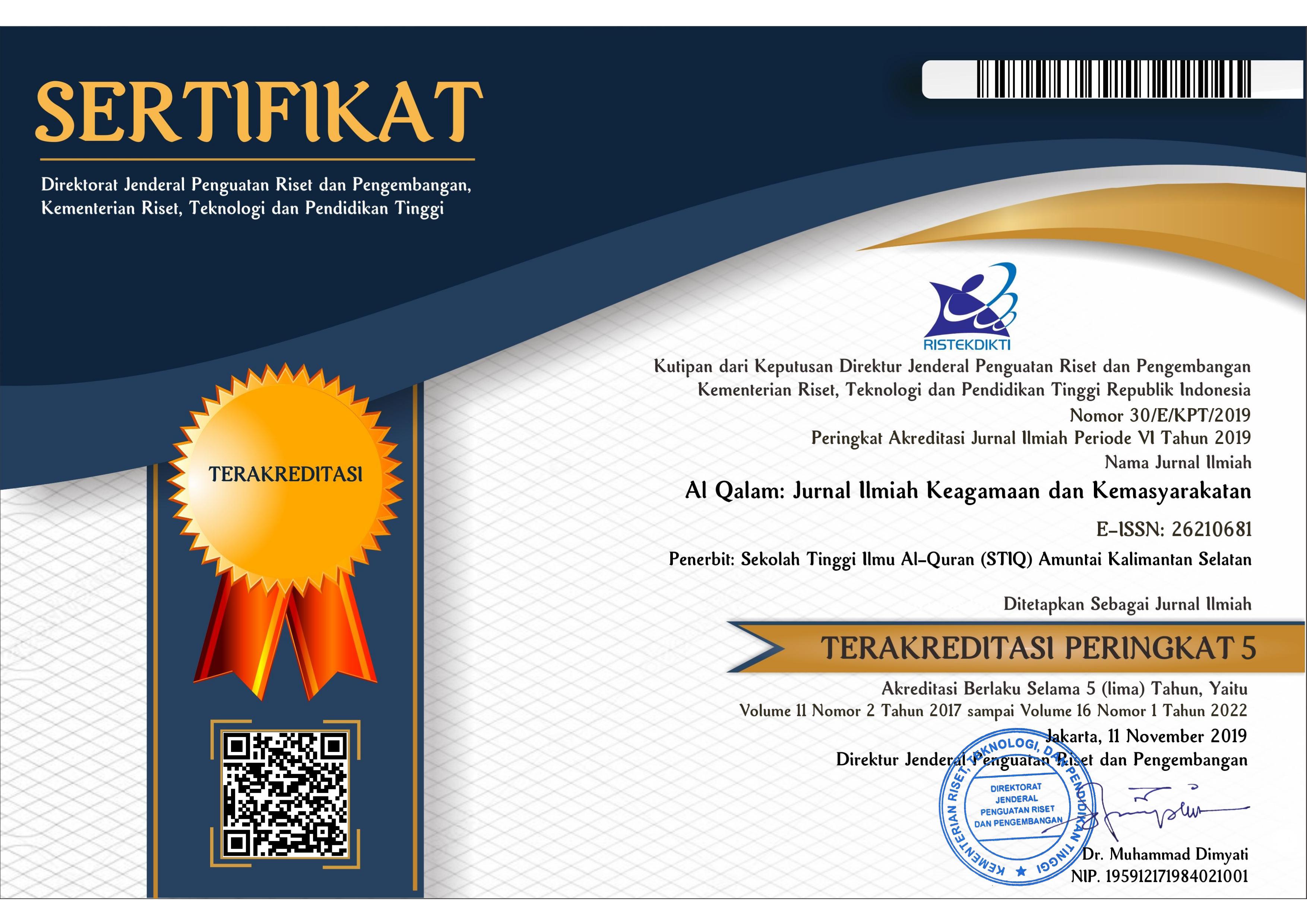
Al Qalam: Jurnal Ilmiah Keagamaan dan Kemasyarakatan, published by Sekolah Tinggi Ilmu Al-Qur'an Amuntai (STIQ Amuntai), is committed to promoting the free and unrestricted dissemination of scholarly knowledge through an open-access publishing model. The journal believes that providing immediate and equitable access to research findings supports academic collaboration, enhances research visibility, and contributes to the advancement of knowledge in Islamic studies, religious studies, education, and related social sciences.
In accordance with the principles of the Budapest Open Access Initiative (BOAI), the journal provides immediate open access to its published content, ensuring that scholarly articles are freely available to researchers, educators, students, institutions, and the general public without financial, subscription, or registration barriers.
Immediate and Free Access
All articles published in Al Qalam: Jurnal Ilmiah Keagamaan dan Kemasyarakatan are made freely accessible through the journal's official website immediately upon publication, without an embargo period. Readers are not required to pay subscription fees, purchase individual articles, or register an account to access published research.
Under this policy, users are permitted to read, download, copy, print, search, link to, and distribute published articles for lawful academic, educational, research, and other purposes, provided that the applicable copyright and licensing requirements are respected.
The journal supports the principle that unrestricted access to scholarly publications facilitates the global exchange of knowledge, strengthens academic communication, and promotes wider participation in scientific development.
Copyright and Creative Commons License
The journal publishes its articles under the Creative Commons Attribution 4.0 International License (CC BY 4.0). This license permits users to share, reproduce, redistribute, adapt, translate, and build upon published materials in any medium or format, including for commercial purposes, provided that appropriate attribution is given to the original authors.
Users must acknowledge the authorship and original publication, provide a link to the applicable license, and indicate whether modifications have been made. These permissions apply to materials covered by the license, while third-party content excluded from the license may require separate authorization.
Authors retain copyright ownership of their published works and grant the journal the non-exclusive right of first publication. This arrangement protects authors' intellectual property rights while encouraging the responsible dissemination and reuse of scholarly knowledge.
License: Creative Commons Attribution 4.0 International (CC BY 4.0)
License URL: https://creativecommons.org/licenses/by/4.0/
Scholarly Dissemination and Accessibility
The journal encourages authors to disseminate their published articles through institutional repositories, personal academic websites, and other legitimate scholarly platforms, with appropriate acknowledgment of the original publication.
Through its Open Journal Systems (OJS) publishing platform, Al Qalam: Jurnal Ilmiah Keagamaan dan Kemasyarakatan provides public access to published issues, article metadata, and full-text publications. The journal also supports the discoverability and preservation of scholarly content to facilitate its continued use by the academic community.
The open-access policy applies to all published articles regardless of the author's institutional affiliation, nationality, or research background. Access to published content is provided without discrimination, supporting inclusive participation in academic research and knowledge exchange.
Commitment to Open Knowledge
Al Qalam: Jurnal Ilmiah Keagamaan dan Kemasyarakatan is dedicated to advancing open and responsible scholarly communication by ensuring that published research remains widely accessible and reusable under clearly defined licensing conditions.
By implementing this policy, the journal seeks to increase the visibility and impact of academic publications, encourage interdisciplinary collaboration, and support the sustainable dissemination of research addressing religious, educational, cultural, and contemporary social issues.
Al Qalam: Jurnal Ilmiah Keagamaan dan Kemasyarakatan
index by:






Publish by:
Sekolah Tinggi Ilmu Al-Qur'an Amuntai
Contact us:
Address: Jl. Rakha Pakapuran, Amuntai Utara
Kabupaten : Hulu Sungai Utara
Kode Pos : 71471
Provinsi : Kalimantan Selatan
Telephone : 085251613000
Email: hafizhihusinsungkar@gmail.com

This work is licensed under a Creative Commons Attribution 4.0 International License