


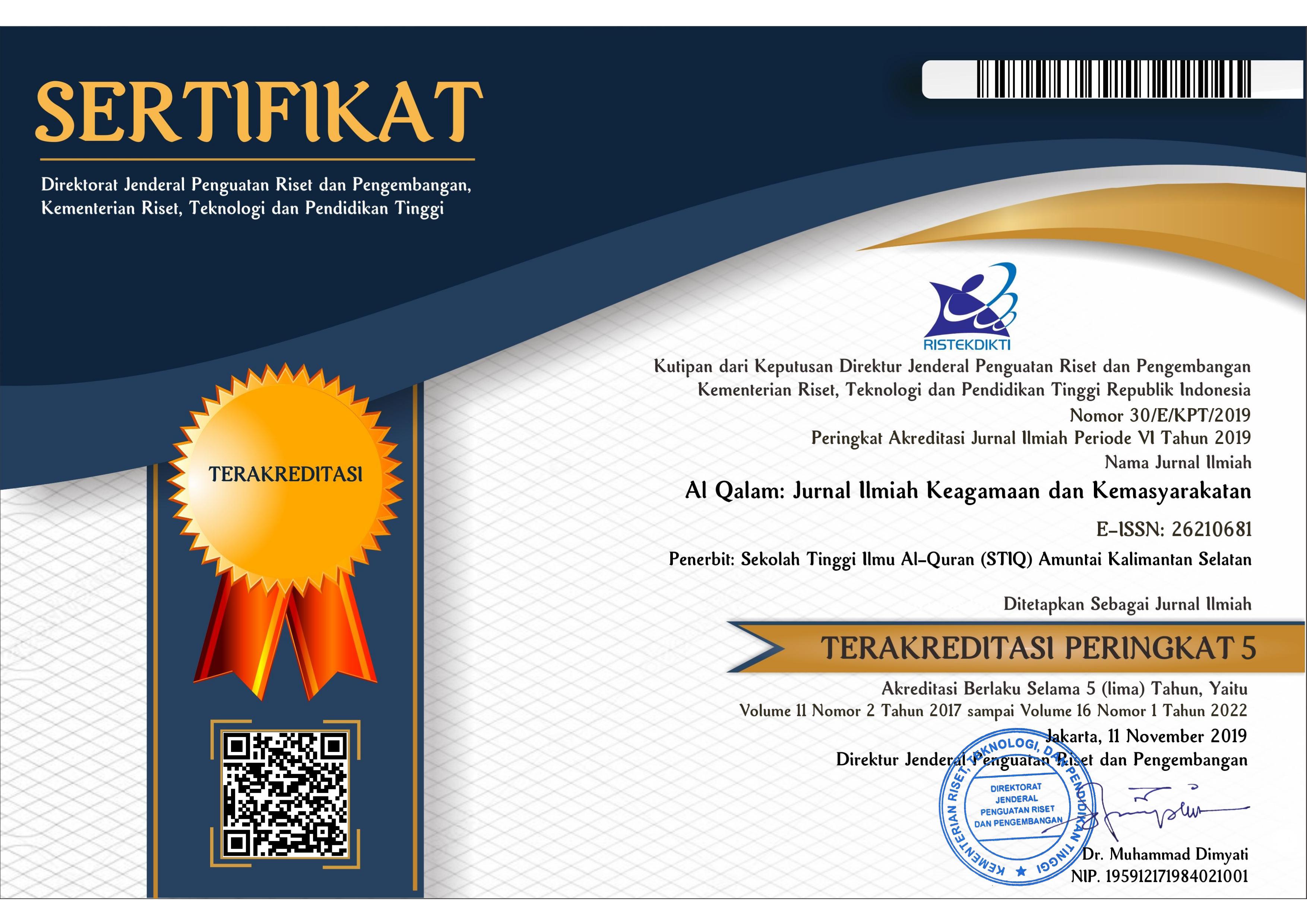
Al Qalam: Jurnal Ilmiah Keagamaan dan Kemasyarakatan, published by Sekolah Tinggi Ilmu Al-Qur'an Amuntai (STIQ Amuntai), is committed to maintaining the highest standards of academic integrity, research ethics, and transparency in scholarly publishing. The journal recognizes that research misconduct undermines the credibility of scientific knowledge and public trust in academic publications. Therefore, all allegations of research misconduct, whether identified before or after publication, will be handled fairly, objectively, and responsibly in accordance with the principles and guidelines established by the Committee on Publication Ethics (COPE).
Types of Research Misconduct
Research misconduct includes unethical practices that compromise the originality, accuracy, reliability, or integrity of scholarly research. Such practices may involve data fabrication, data falsification, inappropriate image manipulation, plagiarism, duplicate publication, citation manipulation, unethical authorship practices, peer-review manipulation, and deliberate misrepresentation of research findings.
Data fabrication refers to inventing research data or results that have not been obtained through legitimate research procedures, while data falsification involves manipulating research materials, processes, or findings in ways that misrepresent the actual results. Inappropriate image manipulation includes altering, duplicating, or selectively modifying visual materials in ways that mislead readers or distort scientific evidence. The journal considers these practices serious violations of research and publication ethics.
Procedures for Handling Allegations
The journal follows relevant COPE guidelines and flowcharts when addressing suspected research misconduct. Allegations may be submitted by reviewers, readers, editors, researchers, or other concerned parties. Reports should contain sufficient information or supporting evidence to enable an appropriate preliminary assessment.
Upon receiving an allegation, the editorial team will evaluate the available evidence and determine whether further investigation is necessary. When appropriate, the corresponding author and other relevant contributors will be contacted and given an opportunity to provide explanations, supporting documentation, or original research data. Allegations will be assessed without presuming misconduct, and confidentiality will be maintained to the extent reasonably possible throughout the investigation.
If the concerns cannot be adequately resolved through editorial assessment, the journal may consult independent experts or contact the authors' affiliated institutions, research ethics committees, or other appropriate authorities for further investigation. The editorial team will cooperate with relevant institutions while ensuring that decisions are based on credible evidence and established publication ethics standards.
Editorial Actions and Publication Integrity
When research misconduct is substantiated, the journal may take appropriate editorial action depending on the nature, severity, and consequences of the violation. For manuscripts under review, such actions may include suspension of the editorial process or rejection of the submission. For published articles, the journal may issue a correction, publish an expression of concern, or retract the article when necessary to protect the integrity of the scholarly record.
Retractions and other post-publication notices will be handled transparently, with clear explanations and appropriate links to the affected publications. The journal distinguishes between honest errors and deliberate misconduct, ensuring that editorial decisions remain proportionate, evidence-based, and consistent with relevant COPE recommendations.
Reporting Research Misconduct
Individuals who identify suspected research misconduct in manuscripts submitted to or articles published by the journal are encouraged to report their concerns to the editorial office. Reports should include relevant details, such as the article title, author information, description of the suspected violation, and any available supporting evidence.
All reports will be treated seriously and evaluated impartially. The journal is committed to protecting the confidentiality of individuals who raise concerns in good faith and ensuring that allegations are handled without unnecessary disclosure or unjustified accusations.
Editorial Contact:
Al Qalam: Jurnal Ilmiah Keagamaan dan Kemasyarakatan
Email: redaksi.alqalam10@gmail.com
Reference to COPE Guidelines
The journal refers to the guidelines and ethical decision-making flowcharts developed by the Committee on Publication Ethics (COPE) when addressing allegations of research and publication misconduct. These resources provide structured procedures for evaluating suspected violations and determining appropriate editorial responses.
Relevant references include:
-
COPE – Fabricated Data in a Submitted Manuscript: https://doi.org/10.24318/cope.2019.2.3
-
COPE – Fabricated Data in a Published Article: https://doi.org/10.24318/cope.2019.2.4
-
COPE – Retraction Guidelines: https://doi.org/10.24318/cope.2019.1.4
-
COPE – Official Website: https://publicationethics.org/
Through the implementation of this policy, Al Qalam: Jurnal Ilmiah Keagamaan dan Kemasyarakatan seeks to uphold responsible research practices, protect the credibility of published scholarship, and maintain public confidence in the integrity of academic publishing.
Al Qalam: Jurnal Ilmiah Keagamaan dan Kemasyarakatan
index by:






Publish by:
Sekolah Tinggi Ilmu Al-Qur'an Amuntai
Contact us:
Address: Jl. Rakha Pakapuran, Amuntai Utara
Kabupaten : Hulu Sungai Utara
Kode Pos : 71471
Provinsi : Kalimantan Selatan
Telephone : 085251613000
Email: hafizhihusinsungkar@gmail.com

This work is licensed under a Creative Commons Attribution 4.0 International License