


Implementation and Development of Akhlakul Karimah Through Religious Activities as a Model at MTs Nurul Huda Mandiangin, Sarolangun Regency, Jambi Province
Abstract
Keywords
Full Text:
PDFReferences
al-Abrasyi, Muhammad ‘Athiyyah. Prinsip-Prinsip Dasar Pendidikan Islam. Jakarta: Bulan Bintang, 2015.
al-Attas, Syed Muhammad Naquib. The Concept of Education in Islam: A Framework for an Islamic Philosophy of Education. Kuala Lumpur: Muslim Youth Movement of Malaysia, 1980.
al-Ghazali, Abu Hamid. Ihya’ ‘Ulum al-Din. Beirut: Dar al-Fikr, 2018.
Ali, Nur, and Salman Al Farisi. “Upaya Orang Tua dalam Membentuk Akhlak Anak di MAN 1 Tebo.” Pendas: Jurnal Ilmiah Pendidikan Dasar 11, no. 3 (2026): 433–50. https://doi.org/10.23969/jp.v11i03.55549.
Bandura, Albert. Social Foundations of Thought and Action: A Social Cognitive Theory. Englewood Cliffs, NJ: Prentice-Hall, 1986.
Baraja, Umar bin Ahmad. al-Akhlaq lil Banin. Surabaya: Maktabah Muhammad bin Ahmad bin Nabhan wa Auladuh, n.d.
Braun, Virginia, and Victoria Clarke. “Using Thematic Analysis in Psychology.” Qualitative Research in Psychology 3, no. 2 (2006): 77–101. https://doi.org/10.1191/1478088706qp063oa.
Bronfenbrenner, Urie. “Ecological Systems Theory.” In Six Theories of Child Development: Revised Formulations and Current Issues, edited by Ross Vasta, 187–249. London: Jessica Kingsley, 1992.
Creswell, John W. Research Design: Qualitative, Quantitative, and Mixed Methods Approaches. 4th ed. Thousand Oaks, CA: SAGE Publications, 2014.
Hafidurrahman, Moh, Moh Dannur, and Fauzan. “Strengthening Students’ Self-Control through Islamic Religious Education Learning in Preventing Bullying.” Al-Riwayah: Jurnal Kependidikan 15, no. 2 (2023): 316–29. https://doi.org/10.47945/al-riwayah.v15i2.1245.
Hakim, Muhammad, and Makmur Syukri. “Teacher Personality Competence in Islamic Moral Education: A Role-Modeling and Character Development Approach.” Journal of Education Research 7, no. 3 (2026): 2398–409. https://doi.org/10.37985/jer.v7i3.4187.
Haq, Khusnamelda Fairushofiddina, and Abu Darda Abu. “Implementasi Metode Habituasi Perspektif Al Ghazali dalam Membentuk Karakter Religius di MI Nurussalam.” Joyful Learning Journal 15, no. 2 (2026): 629–38. https://doi.org/10.15294/jlj.v15i2.46482.
Hurlock, Elizabeth B. Developmental Psychology: A Life-Span Approach. 5th ed. New York: McGraw-Hill, 1980.
Ibn Khaldun. Muqaddimah Ibn Khaldun. Cairo: Dar al-Ma‘arif, 2015.
Ibn Miskawayh. The Refinement of Character (Tahdhib al-Akhlaq). Translated by Constantine K. Zurayk. Beirut: American University of Beirut, 1968.
Khanom, Jobeda, Md. Tarequl Islam, and Fahmi Arfan. “Integrating Classical Islamic Pedagogy with Contemporary Educational Theories: A Pathway to Holistic Learning.” Ishraqi 24, no. 2 (2025): 429–40. https://journals2.ums.ac.id/ishraqi/article/view/15411.
Khoiriyah, Ni’amatul, Zeni Murtafiati Mizani, and Rihab Wit Daryono. “The Influence of Islamic Learning and Parental Support on Students’ Religious Moral through Emotional Intelligence.” Southeast Asian Journal of Islamic Education 6, no. 1 (2023): 75–93. https://doi.org/10.21093/sajie.v6i1.8403.
Kibtiyah, Asriana, Ariga Bahrodin, Yusuf Ahmed Muaz, Khoirul Umam, Hanifuddin, and Khoirotul Idawati. “The Impact of School-Parent Collaboration and Family Environment on Character Education of Students at Madrasah Ibtidaiyah.” Mudarrisa: Jurnal Kajian Pendidikan Islam 17, no. 2 (2025): 161–80. https://doi.org/10.18326/mudarrisa.v17i2.4070.
Korthagen, Fred A. J. “How Teacher Education Can Make a Difference.” Journal of Education for Teaching 36, no. 4 (2010): 407–23.
Lickona, Thomas. Character Matters: How to Help Our Children Develop Good Judgment, Integrity, and Other Essential Virtues. New York: Simon & Schuster, 2004.
Lickona, Thomas. Educating for Character: How Our Schools Can Teach Respect and Responsibility. New York: Bantam Books, 1991.
Lincoln, Yvonna S., and Egon G. Guba. Naturalistic Inquiry. Beverly Hills, CA: SAGE Publications, 1985.
Miles, Matthew B., A. Michael Huberman, and Johnny Saldaña. Qualitative Data Analysis: A Methods Sourcebook. 3rd ed. Thousand Oaks, CA: SAGE Publications, 2014.
Miles, Matthew B., and A. Michael Huberman. Qualitative Data Analysis: An Expanded Sourcebook. 2nd ed. Thousand Oaks, CA: SAGE Publications, 1994.
Nata, Abuddin. Metodologi Studi Islam. Jakarta: RajaGrafindo Persada, 2019.
Nucci, Larry, Darcia Narvaez, and Tobias Krettenauer, eds. Handbook of Moral and Character Education. 2nd ed. New York: Routledge, 2014.
Putra, M. Aditya Tri, and Laily Masruroh. “Strengthening Students’ Discipline through Religious Programs at MAN 1 Jombang.” Journal of Islamic Education Studies 11, no. 1 (2026): 115–44. https://doi.org/10.15642/joies.2026.11.1.115-144.
Putri, Alvia Amalani Mujaroh, and Zudan Rosyidi. “Pembentukan Karakter Religius dan Toleransi Siswa Madrasah Ibtidaiyah melalui Pembiasaan di Madrasah.” Rabbani: Jurnal Pendidikan Agama Islam 5, no. 1 (2024): 58–68. https://doi.org/10.19105/rjpai.v5i1.11727.
Ryan, Richard M., and Edward L. Deci. “Self-Determination Theory and the Facilitation of Intrinsic Motivation, Social Development, and Well-Being.” American Psychologist 55, no. 1 (2000): 68–78. https://doi.org/10.1037/0003-066X.55.1.68.
Shihab, M. Quraish. Wawasan al-Qur’an: Tafsir Maudhu’i atas Pelbagai Persoalan Umat. Bandung: Mizan, 2019.
Stake, Robert E. The Art of Case Study Research. Thousand Oaks, CA: SAGE Publications, 1995.
Tilaar, H. A. R. Pengembangan Sumber Daya Manusia dalam Era Globalisasi. Jakarta: Grasindo, 2012.
Yin, Robert K. Case Study Research and Applications: Design and Methods. 6th ed. Thousand Oaks, CA: SAGE Publications, 2018.
DOI: http://dx.doi.org/10.35931/aq.v20i6.7595
Refbacks
- There are currently no refbacks.
Copyright (c) 2026 Suparno Suparno, Hairul Fauzi, M. Hadri Hasan, Muhammad Muhammad, Kholilullah Kholilullah

This work is licensed under a Creative Commons Attribution 4.0 International License.
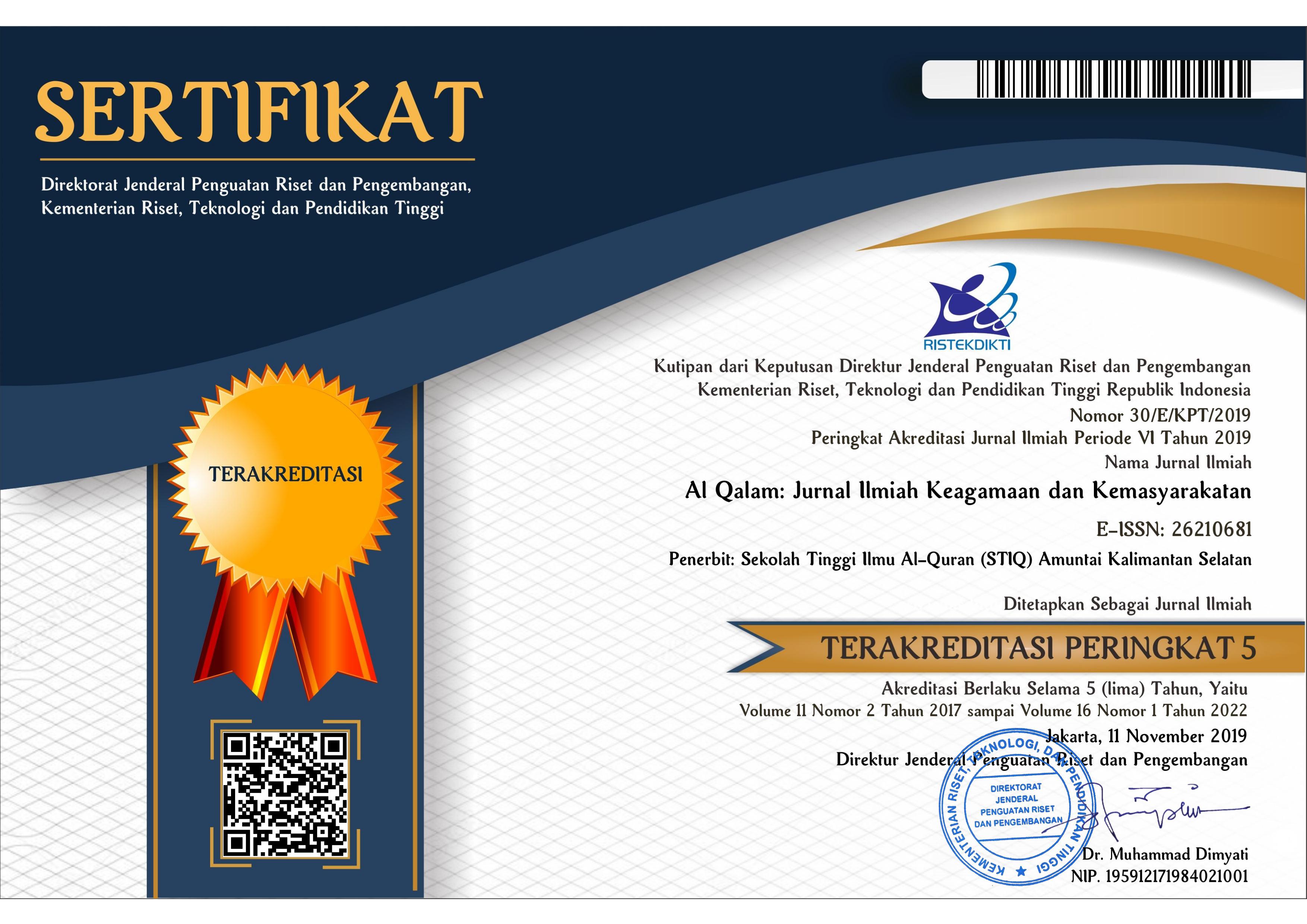
Al Qalam: Jurnal Ilmiah Keagamaan dan Kemasyarakatan
index by:







Publish by:
Sekolah Tinggi Ilmu Al-Qur'an Amuntai
Contact us:
Address: Jl. Rakha Pakapuran, Amuntai Utara
Kabupaten : Hulu Sungai Utara
Kode Pos : 71471
Provinsi : Kalimantan Selatan
Telephone : 085251613000
Email: hafizhihusinsungkar@gmail.com

This work is licensed under a Creative Commons Attribution 4.0 International License