



Influence of Psychopreneurship and Digital Capability on the Operational Independence of Micro Enterprises in the City of Bandung
Abstract
Micro businesses play a strategic role in the Indonesian economy, but still face challenges in achieving sustainable operational independence, particularly amid the demands of psychological adaptation to entrepreneurship and digital transformation. This study aims to analyse the influence of psychopreneurship and digital capability on the operational independence of micro businesses in Bandung City. The study uses a quantitative approach with a survey method of 280 micro business actors, which is analysed using Partial Least Squares–Structural Equation Modelling (PLS-SEM). The results of the analysis show that psychopreneurship has a positive and significant effect on the operational independence of micro businesses (β = 0.604), while digital capability also has a positive and significant effect (β = 0.121). Simultaneously, psychopreneurship and digital capability were able to explain 37.1% of the variation in the operational independence of micro businesses (R² = 0.371), indicating that operational independence is the result of the integration of the psychological readiness for entrepreneurship and the digital capabilities of business actors. This study contributes to the development of entrepreneurship literature by integrating the concepts of psychopreneurship and digital capability into a single empirical model, as well as providing practical implications for the development of more holistic and sustainable micro-business empowerment policies and programmes.
Keywords
Full Text:
PDFReferences
Ayala, J. C., and G. Manzano. “The Resilience of the Entrepreneur: Influence on the Success of the Business.” International Small Business Journal 39, no. 5 (2021): 417–37.
Badan Pusat Statistik. Statistik UMKM Indonesia 2023–2024. BPS, 2024.
Bresciani, S., A. Ferraris, G. Santoro, and M. Del Giudice. “The Management of Organizational Ambidexterity through Alliances in a New Context of Analysis.” Journal of Business Research 123 (2021): 413–25.
Bullough, A., M. Renko, and T. Myatt. “Danger Zone Entrepreneurs: The Importance of Resilience and Self-Efficacy.” Entrepreneurship Theory and Practice 45, no. 2 (2021): 454–78.
Chen, Y., R. Croson, and Z. Lei. “Entrepreneurial Self-Efficacy and Venture Performance.” Journal of Economic Behavior & Organization 176 (2020): 375–95.
Creswell, J. W. Research Design: Qualitative, Quantitative, and Mixed Methods Approaches. 5th ed. Sage Publications, 2018.
Elia, G., A. Margherita, and G. Passiante. “Digital Entrepreneurship Ecosystem: How Digital Technologies and Collective Intelligence Shape Entrepreneurial Opportunities.” Technological Forecasting and Social Change 162 (2021): 120–33.
Faizan Iza Zainuddin, F. I., A. F. Hilary, and N. S. Salma. “Entrepreneurial Mindset and Digital Transformation: A Systematic Review of Principal Success Factors.” International Journal of Business Management 7, no. 2 (2025): 33–49.
Fisher, R., A. Maritz, and A. Lobo. “Does Individual Resilience Influence Entrepreneurial Success?” Journal of Business Venturing 35, no. 3 (2020): 105–21.
Hair, J. F., G. T. M. Hult, C. M. Ringle, and M. Sarstedt. A Primer on Partial Least Squares Structural Equation Modeling (PLS-SEM). 3rd ed. Sage Publications, 2021.
Kementerian Koperasi dan Usaha Kecil dan Menengah Republik Indonesia. Perkembangan Data Usaha Mikro, Kecil, Dan Menengah (UMKM) Indonesia 2023–2024. KemenKopUKM RI, 2024.
Kraus, S., S. Durst, J. J. Ferreira, P. Veiga, N. Kailer, and A. Weinmann. “Digital Transformation in Business and Management Research: An Overview.” Journal of Business Research 141 (2022): 346–62.
Musyafaah, Y., and D. S. Budiarto. “Jiwa Kewirausahaan Dan Kinerja Operasional UMKM.” Jurnal Riset Akuntansi Mercu Buana, 2025.
Newman, A., M. Obschonka, S. Schwarz, M. Cohen, and I. Nielsen. “Entrepreneurial Self-Efficacy: A Systematic Review.” Journal of Management 45, no. 3 (2019): 123–46.
Rialti, R., L. Zollo, A. Ferraris, and I. Alon. “Big Data Analytics Capabilities and Performance.” Management Decision 58, no. 8 (2020): 1714–34.
Sari, S. M., Y. Yunizar, and D. Sartika. “Kompetensi Digital Dan Orientasi Kewirausahaan Sebagai Penentu Keunggulan Bersaing UMKM.” AdBispreneur: Jurnal Pemikiran Dan Penelitian Administrasi Bisnis Dan Kewirausahaan 10, no. 1 (2025): 45–60.
Sekaran, U., and R. Bougie. Research Methods for Business: A Skill-Building Approach. 8th ed. Wiley, 2020.
Supriyono. “Transformasi Digital Sebagai Urgensi Strategis Untuk Meningkatkan Kinerja UMKM Di Indonesia: Peran Kapabilitas Teknologi Dan Orientasi Kewirausahaan.” YUME: Journal of Management, 2025.
Teece, D. J. “Business Models and Dynamic Capabilities.” Long Range Planning 51, no. 1 (2018): 40–49.
Vial, G. “Understanding Digital Transformation.” MIS Quarterly 43, no. 1 (2019): 223–55.
Warner, K. S. R., and M. Wäger. “Building Dynamic Capabilities for Digital Transformation.” Long Range Planning 52, no. 3 (2019): 326–49.
DOI: http://dx.doi.org/10.35931/aq.v20i5.6400
Refbacks
- There are currently no refbacks.
Copyright (c) 2026 Pras Rendy, Kartika Nuradina

This work is licensed under a Creative Commons Attribution 4.0 International License.
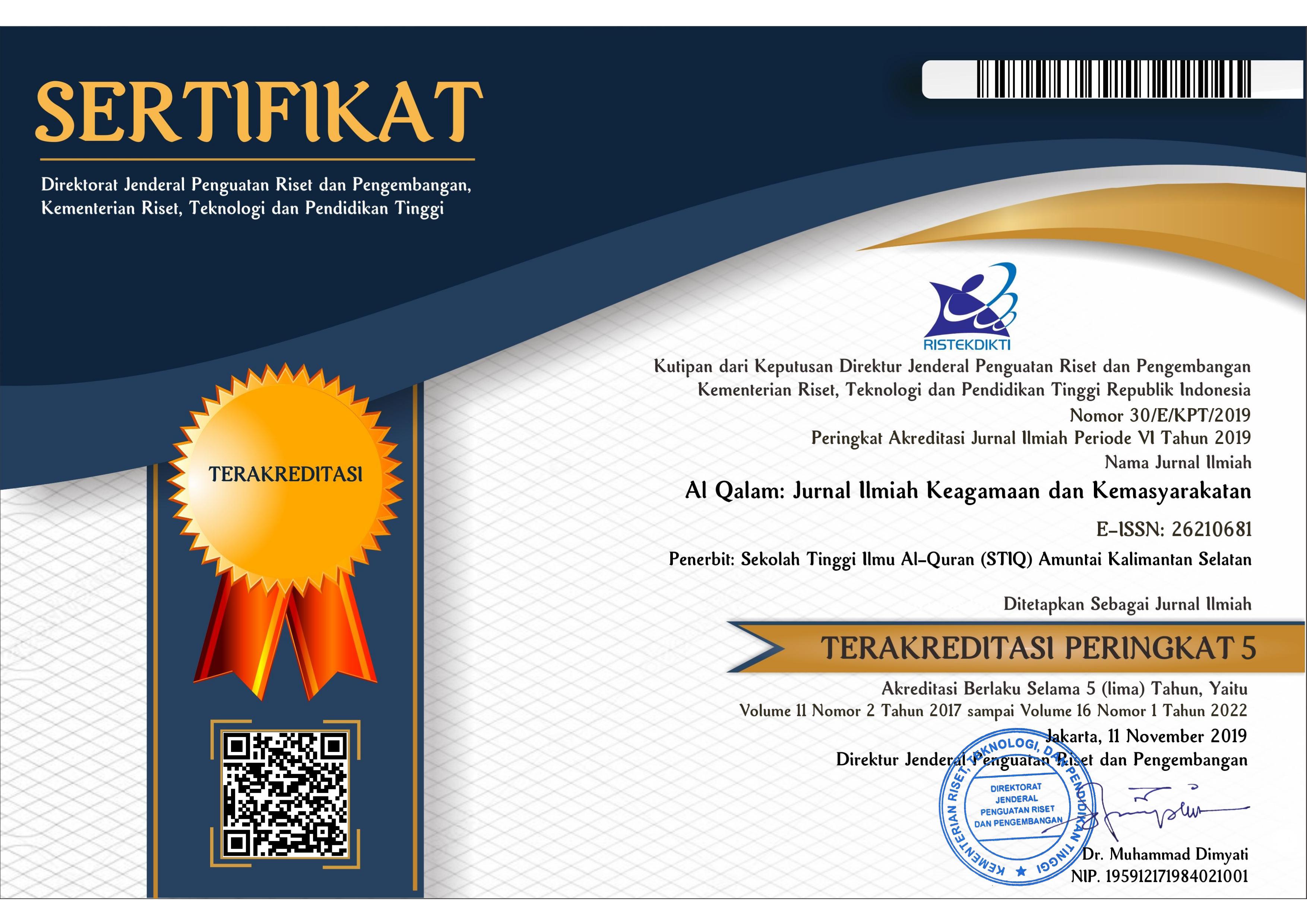
Al Qalam: Jurnal Ilmiah Keagamaan dan Kemasyarakatan
index by:










Publish by:
Sekolah Tinggi Ilmu Al-Qur'an Amuntai
Contact us:
Address: Jl. Rakha Pakapuran, Amuntai Utara
Kabupaten : Hulu Sungai Utara
Kode Pos : 71471
Provinsi : Kalimantan Selatan
Telephone : 085251613000
Email: hafizhihusinsungkar@gmail.com

This work is licensed under a Creative Commons Attribution 4.0 International License