



Differences Between Learning Models and Students' Cognitive Styles on Students' Learning Outcomes in the Geography Subject at State Senior High School 59 Jakarta
Abstract
This research is to examine: (1) was there any difference in geography learning outcomes between students taught using the Numbered Heads Together (NHT) model and those taught using the Student Teams Achievement Division (STAD) mode. (2) was there any difference in in geography learning outcomes between students with a Field Independent (FI) cognitive style and those with a Field Dependent (FD) cognitive style within the NHT model group. This research was done at Senior High School 59 Jakarta. from October 2024 - July 2025. The method used in this study is an experimental method with a post-test only control group design. The population included all student from Senior High School 59 Jakarta., specifically three class, class XI-4, XI-5, and XI-7, with a total of 107 students, and the sample used in this study was 72 students from classes XI-5 and XI-7, selected using purposive sampling techniques. The instruments used included multiple-choice post-tests via Google Forms, as well as cognitive style questionnaires given via Google Forms as well. Based on data analysis using the Mann-Whitney test, the result showed p = 0.572 > 0.05, It can be concluded that there was no significant statistical difference in students’ learning outcomes between those taught using the NHT model (XI-7) and those using the STAD model (XI-5). Furthermore, based on data analysis using the Mann-Whitney test, the result showed p = 0,951 > 0,05 so that analysis of Geography learning outcomes between students taught using the NHT model with Field Independent (FI) and Field Dependent (FD) cognitive styles indicated no statistically significant difference.
Keywords
Full Text:
PDFReferences
Anita, Lie. Mempraktikan Cooperative Learning Diruang-Ruang Kelas. Grasindo, 2000.
Hastari, Marwinda. “Penerapan Metode Numbered Heads Together (NHT) untuk Meningkatkan Hasil Belajar Mata Diklat Teknik Penggunaan Suhu Rendah di SMK Negeri 1 Pandak.” Universitas Negeri Yogyakarta, 2012.
Kurniawan, Deni. Pembelajaran Terpadu Tematik. Alfabeta, 2019.
Purwanto. Evaluasi Hasil Belajar. Pustaka Belajar, 2011.
Rusman. Learning Models: Developing Teacher Professionalism. Rajawali Pers, 2012.
Slameto. Belajar Dan Faktor-Faktor Yang Mempengaruhinya. Rineka Cipta, 2003.
Sugiyono. Educational Research Methods: Quantitative, Qualitative, and R&D Approaches. Alfabeta, 2009.
Suprihatiningrum, J. Learning Models. Ar-Ruzz Media, 2012.
Syamsu, F. N., I. Rahmawati, and Suyitno. “The Effectiveness of the STAD Learning Model on Mathematics Learning Outcomes in Spatial Geometry.” International Journal of Elementary Education 3, no. 3 (2019): 346–52.
Walpole, R. E. Introduction to Statistics. Gramedia Pustaka Utama, 1995.
Wulandari, I. “STAD (Student Teams Achievement Division) Type Cooperative Learning Model in MI Learning.” Papeda Journal 4, no. 1 (2022).
DOI: http://dx.doi.org/10.35931/aq.v20i2.6422
Refbacks
- There are currently no refbacks.
Copyright (c) 2026 Rangga Panji Keswara, Muhammad Zid, Ode Sofyan Hardi

This work is licensed under a Creative Commons Attribution 4.0 International License.
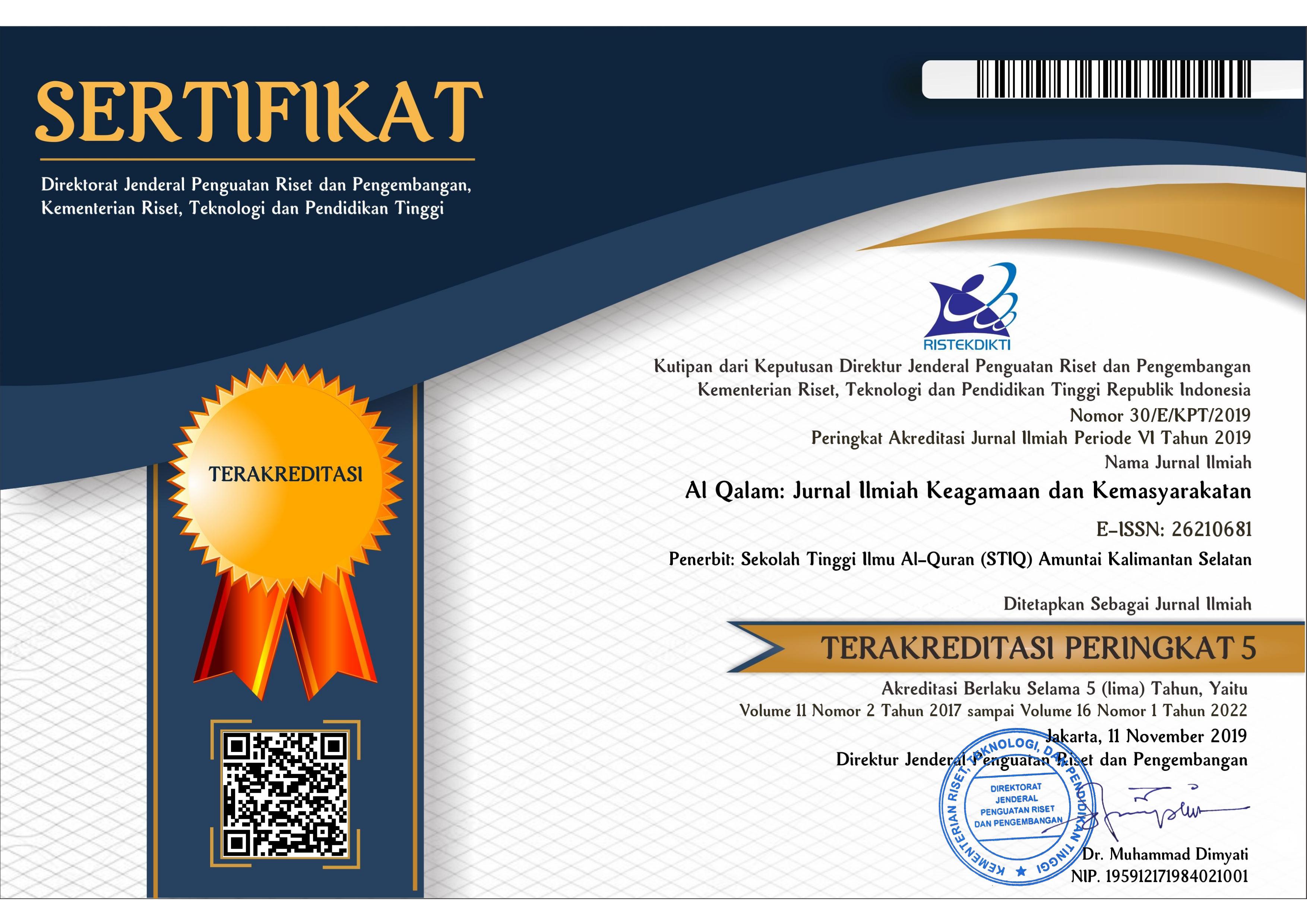
Al Qalam: Jurnal Ilmiah Keagamaan dan Kemasyarakatan
index by:










Publish by:
Sekolah Tinggi Ilmu Al-Qur'an Amuntai
Contact us:
Address: Jl. Rakha Pakapuran, Amuntai Utara
Kabupaten : Hulu Sungai Utara
Kode Pos : 71471
Provinsi : Kalimantan Selatan
Telephone : 085251613000
Email: hafizhihusinsungkar@gmail.com

This work is licensed under a Creative Commons Attribution 4.0 International License