


The Influence of Knowledge Management Effectiveness and Organizational Culture on the Performance of Buddhist Sunday School Teachers in Makassar
Abstract
This study aims to identify the influence of management effectivenessthe influence of knowledge and organizational culture on the performance of teachers in schoolsSunday Buddhist Schools (SMB) spread across the Makassar region. The independent variables in this study are the effectiveness of knowledge management (X1) and organizational culture (X2), while the dependent variable is teacher performance (Y). The analytical approach used in this study is multiple linear regression to examine the contribution of each independent variable to teacher performance. The sample was determined using a probability sampling technique, with a total of 86 respondents. Primary data was obtained through a questionnaire distributed online via Google Form. Hypothesis testing was conducted using SPSS software version 20.0 for Windows. The results of the studyThis study demonstrates that effective knowledge management and organizational culture play a significant role in improving the performance of Buddhist Sunday School teachers in Makassar City. Well-managed knowledge management can help teachers access, manage, and utilize relevant information to support learning activities. Meanwhile, a supportive organizational culture fosters a harmonious work environment, increases motivation, and strengthens teachers' commitment to their responsibilities as educators. Simultaneously, these two factors complement each other in creating conditions conducive to improving teacher performance.
Keywords
Full Text:
PDFReferences
Alhakim, Bintang, and Suhana. “Pengaruh Gaya Kepemimpinan, Knowledge Management Dan Budaya Organisasi Terhadap Kinerja Karyawan.” Al-Kharaj: Jurnal Ekonomi, Keuangan & Bisnis Syariah 6, no. 5 (2024): 4525–35. https://doi.org/10.47467/alkharaj.v6i5.1791.
Arsyad, Siti Fatimatul Azzahra, and Ari Anggarani W. P. T. “Pengaruh Knowledge Management Dan Budaya Organisasi Terhadap Komitmen Organisasional Melalui Learning Organization.” Jurnal Penelitian Ekonomi Manajemen Dan Bisnis 1, no. 4 (2022): 81–94. https://doi.org/10.55606/jekombis.v1i4.634.
Artha, I. Wayan Wikananda Radina, and Syarifudin. “Pengaruh Budaya Organisasi, Knowledge Management, Dan Leader-Member Exchange Terhadap Kinerja Karyawan Divisi Infrastruktur 2 PT Pembangunan Perumahan (Persero) Tbk Jakarta.” Publik: Jurnal Manajemen Sumber Daya Manusia, Administrasi Dan Pelayanan Publik 10, no. 2 (2023): 433–45. https://doi.org/10.37606/publik.v10i2.612.
Gibson, J. L., J. M. Ivancevich, J. H. J. Donnelly, and R. Konopaske. “Organizations: Behavior, Structure, and Processes.” In Edisi ke-14. Diedit oleh P. Ducham. McGraw-Hill, 2012.
Luthans, F. Organizational Behavior: An Evidence-Based Approach. Edisi ke-12. Diedit oleh Jane Beck. McGraw-Hill, 2011. https://doi.org/10.5005/jp/books/10358_23.
Marquardt, M. J. Building the Learning Organization: Mastering the 5 Elements for Corporate Learning. Davies-Black Pub, 2011.
Matin, E. K., and B. H. Kashani. “Comparing Degree of Readiness for Implementation of Knowledge Management in Public and Private Universities in Iran.” Interdisciplinary Journal of Contemporary Research in Business 4 (2012): 623–34. http://sfx.scholarsportal.info/mcmaster?sid=OVID:psycdb&id=pmid:&id=doi:&issn=2044-4621&isbn=&volume=4&issue=4&spage=623&pages=623-634&date=2012&title=Interdisciplinary+Journal+of+Contemporary+Research+in+Business&atitle=Comparing+degree+of+readiness+for+.
Pratama, Reza Adit. “Pengaruh Faktor-Faktor Knowledge Management Melalui Attitude Yang Dimoderasi Oleh Kepemimpinan Dan Budaya Organisasi Terhadap Intention (Studi Kasus Pada PT PLN (Persero) UIP JBT).” Jurnal EMT KITA 9, no. 2 (2025): 553–72. https://doi.org/10.35870/emt.v9i2.3912.
Rao, M. Knowledge Management: Tools and Techniques. Edited by Diedit M. Rao. Elsevier Butterworth-Heinemann, 2014. https://doi.org/10.1007/978-1-62703-50-2_5.
Satriadi. “Pengaruh Kepemimpinan Kepala Sekolah dan Manajemen Kepala Sekolah terhadap Kinerja Guru.” Jurnal Benefita 1, no. 3 (2016): 123–33. https://doi.org/10.22216/jbe.v1i3.874.
Supardi. Kinerja Guru. RajaGrafindo Persada, 2013.
Syamsuddin, Syamsuddin, Chahyono Chahyono, and Haeruddin Saleh. “Analisis Penerapan Knowledge Management Dan Budaya Organisasi Terhadap Kinerja Pegawai Melalui Kepuasan Kerja Pada Kantor DPRD Kabupaten Maros.” Indonesian Journal of Business and Management 5, no. 1 (2022): 82–94. https://doi.org/10.35965/jbm.v5i1.1867.
Triwahyuni, Lulus, Thamrin Abdullah, and Widodo Sunaryo. “The Effect of Organizational Culture, Transformational Leadership and Self-Confidence to Teachers Performance.” International Journal of Managerial Studies and Research 2, no. 10 (2014): 156–65.
Wibowo. Manajemen Kinerja. Edisi ke-5. Rajawali Pers, 2016.
Wirawan. Budaya dan Iklim Organisasi: Teori, Aplikasi, dan Penelitian. Salemba Empat, 2008.
Yadnyawati, Ida Ayu Gede, Muljadi, and Erny. “Pengaruh Antara Efektivitas Knowledge Management Dan Budaya Organisasi Terhadap Kinerja Guru Sekolah Minggu Buddha (SMB) Chong-De Se Sumatera Utara.” Dhammavicaya : Jurnal Pengkajian Dhamma 6, no. 1 (2022): 26–36. https://doi.org/10.47861/dv.v6i1.47.
DOI: http://dx.doi.org/10.35931/aq.v20i2.6437
Refbacks
- There are currently no refbacks.
Copyright (c) 2026 Suzanna Suzanna, Liana The, Adrian Adrian

This work is licensed under a Creative Commons Attribution 4.0 International License.
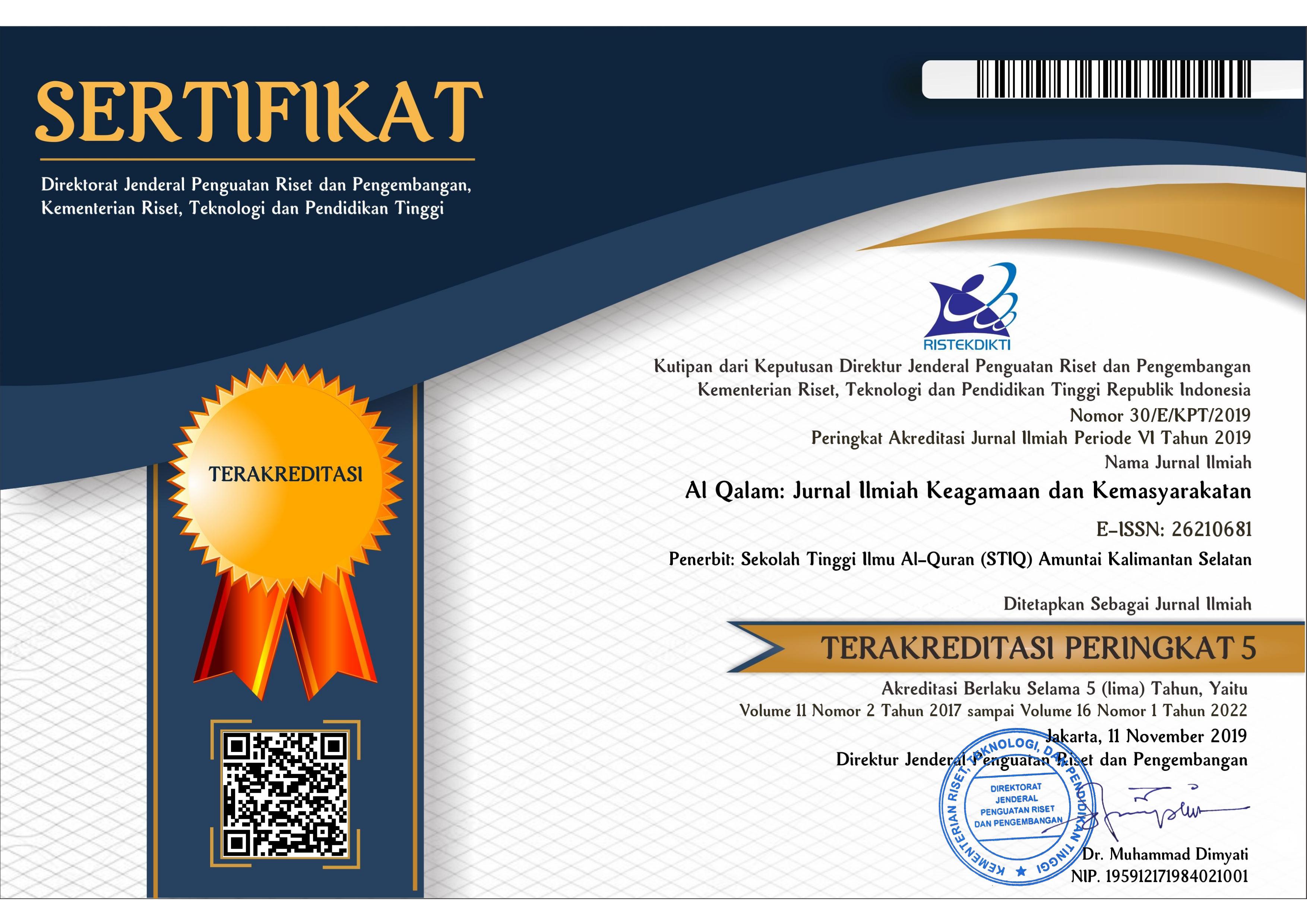
Al Qalam: Jurnal Ilmiah Keagamaan dan Kemasyarakatan
index by:










Publish by:
Sekolah Tinggi Ilmu Al-Qur'an Amuntai
Contact us:
Address: Jl. Rakha Pakapuran, Amuntai Utara
Kabupaten : Hulu Sungai Utara
Kode Pos : 71471
Provinsi : Kalimantan Selatan
Telephone : 085251613000
Email: hafizhihusinsungkar@gmail.com

This work is licensed under a Creative Commons Attribution 4.0 International License