


Pluralism in Islam: A Comparative Analysis of the Thought Constructions of Ibn Arabi and Fazlur Rahman
Abstract
Pluralism in Islam is a crucial issue in contemporary Muslim societies confronted with the reality of religious and belief diversity. This study aims to analyze and compare the concept of pluralism in the thought constructions of Ibn Arabi and Fazlur Rahman, and to formulate its implications for the development of Islamic pluralism discourse in the context of modern Muslim societies, particularly in Indonesia. This study uses a qualitative approach with library research. Data were obtained from the construction of the two figures' thoughts, supported by relevant secondary literature, and then analyzed using a comparative-interpretive approach to identify indicators of pluralism in the aspects of interfaith truth, religious freedom, and social ethics. The results show that Ibn Arabi's thought construction interprets pluralism within a spiritual-Sufi framework through the concept of the religion of love, which encourages inclusiveness and respect for differences in belief. Meanwhile, Fazlur Rahman positions pluralism as an ethical consequence of the universal message of the Quran through an ethical-historical approach and the double movement method. This study concludes that the relevant pluralism in Islam is theologically limited ethical-social pluralism, which functions to guarantee justice, religious freedom, and respect for human dignity without negating the principles of Islamic faith.
Keywords
Full Text:
PDFReferences
Addas, Claude. Quest for the Red Sulphur: The Life of Ibn ‘Arabi. Cambridge: Islamic Texts Society, 1993.
Attas, Syed Muhammad Naquib al-. Islam and Secularism. Kuala Lumpur: ISTAC, 1993.
Auda, Jasser. Maqasid al-Shariah as Philosophy of Islamic Law. London: IIIT, 2008.
Azmi, Muhyidin. “Interpretasi Nurcholish Madjid atas Ayat-Ayat Al-Qur’an tentang Pluralisme Agama.” Tanzil: Jurnal Studi Al-Quran 5, no. 2 (2023): 101–12. https://doi.org/10.20871/TJSQ.V5I2.232.
Creswell, John W. Research Design: Qualitative, Quantitative, and Mixed Methods Approaches. Thousand Oaks, CA: Sage, 2014.
Dian, Imas Masripah, Dela Purwandani, Deagi Nur Mohamad Maliki, and Fadhilah Anggraini Pane. “Nurcholish Madjid’s Perspective About Thought of Religious Pluralism.” Munaddhomah: Jurnal Manajemen Pendidikan Islam 3, no. 2 (2022): 139–48. https://doi.org/10.31538/munaddhomah.v3i2.242.
Dute, Hasruddin, M. Zainul Hasani Syarif, and Yunus. “Islam dan Pluralisme Pendidikan Agama.” Al-Riwayah: Jurnal Kependidikan 13 (2021): 225–412. https://e-jurnal.iainsorong.ac.id/index.php/Al-Riwayah.
Fadel, Mohammad. “Political Liberalism, Islamic Family Law, and Family Law Pluralism.” Wake Forest Law Review (2012): 130–33.
Fakhrudi, Haris. “Perspektif Ibnu Arabi tentang Konsep Kebebasan dalam Tasawuf.” Teosofi: Jurnal Tasawuf dan Pemikiran Islam 2, no. 2 (2012): 248–64.
Farobi, Al Muhammad, and Ulya Zahrotul Firdaus. “Multikulturalisme Indonesia Perspektif Fazlur Rahman.” Realita: Jurnal Penelitian dan Kebudayaan Islam 22, no. 1 (2024): 112–28. https://doi.org/10.30762/REALITA.V22I1.289.
Fikri, Zainal. Gus Dur, Pluralisme Agama, dan Demokrasi. Banjarmasin: IAIN Antasari Press, 2013.
Ghazali, Abdul Moqsith. Argumen Pluralisme Agama. Depok: Kata Kita, 2009.
Hakim, Souad. “Unity of Being in Ibn Arabi: A Humanist Perspective.” Journal of the Muhyiddin Ibn Arabi Society (2004): 41–52.
Hallaq, Wael B. The Impossible State: Islam, Politics, and Modernity’s Moral Predicament. New York: Columbia University Press, 2013.
Hasan, Moh. Abdul Kholiq. “Interfaith Tolerance and Its Relevance to the Indonesian Diversity: A Study on Ibn ‘Āshūr’s al-Taḥrīr wa al-Tanwīr.” Ulumuna 22, no. 2 (2018): 333–62. https://doi.org/10.20414/ujis.v22i2.301.
Hasan, Moh. Abdul Kholiq. “Merajut Kerukunan dalam Keragaman Agama di Indonesia (Perspektif Nilai-Nilai Al-Qur’an).” Profetika: Jurnal Studi Islam 14, no. 1 (2013): 66–77. https://doi.org/10.23917/profetika.v14i1.2008.
Hidayatullah, Fauzan. “Analisis Pandangan Abdul Moqsith Ghazali dan Hamid Fahmy Zarkasyi terhadap Pluralisme Agama dalam Penafsiran Ayat-Ayat Al-Quran.” Jurnal Pemikiran Islam 3, no. 1 (2023): 28–39. https://doi.org/10.22373/JPI.V3I1.16858.
Hidayatulloh, Taufik, Theguh Saumantri, Hajam, and Wahyudi Akmaliah. “Ibn Arabi’s Hermeneutics as an Alternative Religious Exegesis for Contemporary Urban Muslim Communities.” Akademika: Jurnal Pemikiran Islam 30, no. 1 (2025): 61–76. https://doi.org/10.32332/akademika.v30i1.10082.
Ibn Arabi, Muhyiddin. Al-Futuhat al-Makkiyyah. Beirut: Dar al-Turath, 1980.
Ibn Arabi, Muhyiddin. Diwan Tarjuman al-Asywaq. Beirut: Dar al-Ma‘arif, 2005.
Ibn Arabi, Muhyiddin. Dzakha’ir al-A‘laq Syarh Tarjuman al-Asywaq. Cairo: Ein for Human and Social Studies, 1995.
Karomi, Kholid. “Penolakan Ibnu Arabi terhadap Pluralisme Agama.” Kalimah 12 (2014): 49–66. https://doi.org/10.21111/klm.v12i1.218.
Nasr, Seyyed Hossein. Islamic Philosophy from Its Origin to the Present. New York: SUNY Press, 2006.
Rahman, Fazlur. Islam and Modernity: Transformation of an Intellectual Tradition. Chicago: University of Chicago Press, 1982.
Rahman, Fazlur. Major Themes of the Qur’an. Chicago: Bibliotheca Islamica, 1980.
Ramadan, Tariq. To Be a European Muslim. Leicester: The Islamic Foundation, 1999.
Rozaq, Abd. “Qur’anic Hermeneutics and Its Applications by Fazlur Rahman.” International Journal of Islamicate Social Studies 1, no. 2 (2023): 121–31. https://doi.org/10.62039/ijiss.v1i2.27.
Saeed, Abdullah. Interpreting the Qur’an: Towards a Contemporary Approach. New York: Routledge, 2006.
Saeed, Abdullah. Islam and Religious Freedom. Oxford: Oxford University Press, 2014.
Wahid, Abdurrahman. Islamku, Islam Anda, Islam Kita: Agama Masyarakat Negara Demokrasi. Jakarta: The Wahid Institute, 2006.
Wasurip, Moh Rafi Irvanul Vaza, and Zaenul Mahmudi. “Implementasi Keadilan Sosial Double Movement Fazlur Rahman dalam Pembagian Harta Waris Keluarga Adat Jawa.” Al-Manhaj: Journal of Indonesian Islamic Family Law 6, no. 2 (2024): 198–213. https://doi.org/10.19105/al-manhaj.v6i2.16200.
Zed, Mestika. Metode Penelitian Kepustakaan. Jakarta: Yayasan Obor Indonesia, 2008.
DOI: http://dx.doi.org/10.35931/aq.v20i6.6550
Refbacks
- There are currently no refbacks.
Copyright (c) 2026 Muhammad Furqon Alkalam, Moh Abdul Kholiq Hasan

This work is licensed under a Creative Commons Attribution 4.0 International License.
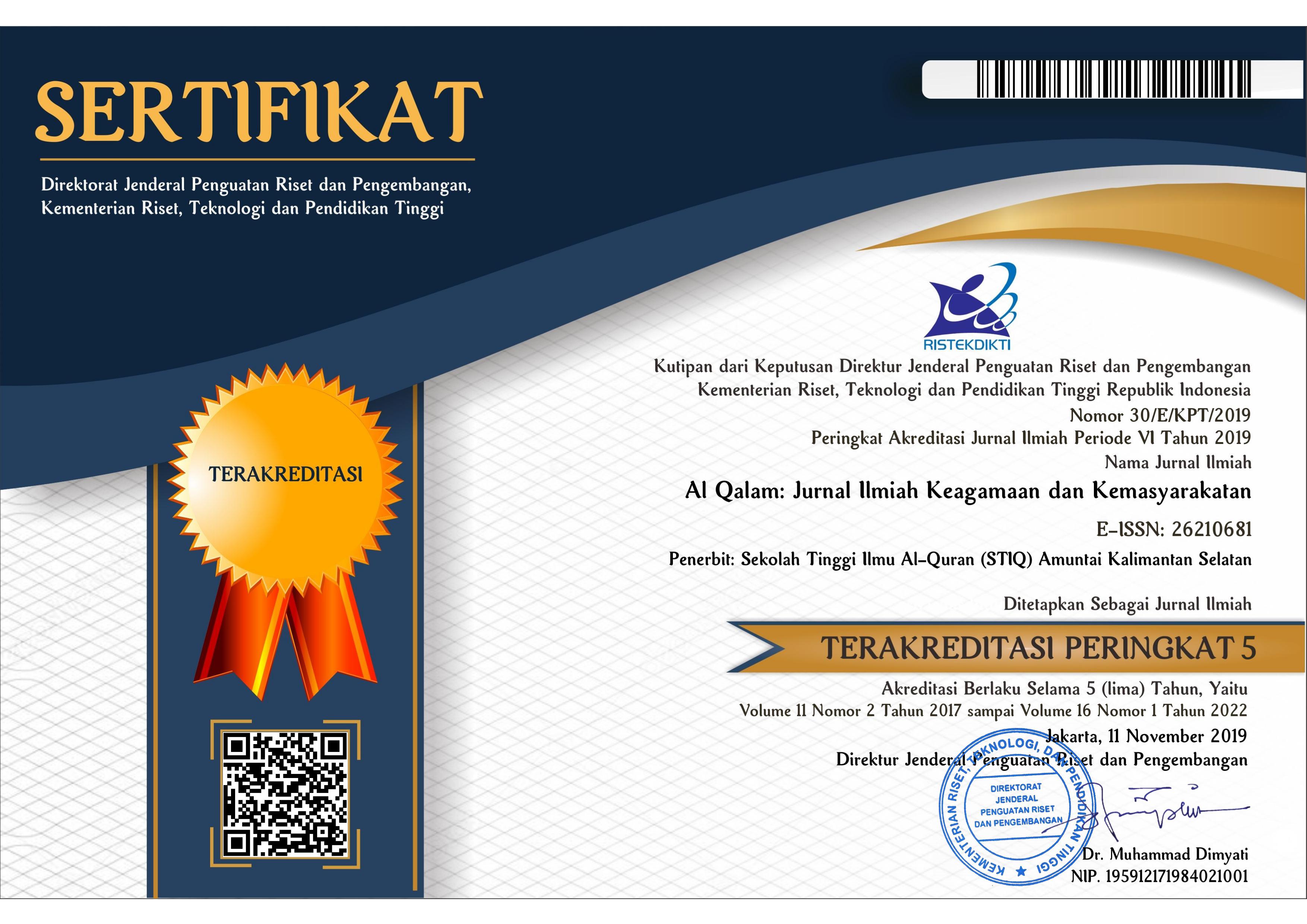
Al Qalam: Jurnal Ilmiah Keagamaan dan Kemasyarakatan
index by:








Publish by:
Sekolah Tinggi Ilmu Al-Qur'an Amuntai
Contact us:
Address: Jl. Rakha Pakapuran, Amuntai Utara
Kabupaten : Hulu Sungai Utara
Kode Pos : 71471
Provinsi : Kalimantan Selatan
Telephone : 085251613000
Email: hafizhihusinsungkar@gmail.com

This work is licensed under a Creative Commons Attribution 4.0 International License