



The Effect of Flipbook Media on Elementary School Students’ Motivation and Mathematics Learning Outcomes
Abstract
This study examines the effect of using flipbook media on motivation and cognitive learning outcomes in elementary school mathematics. It employed a quasi-experimental design involving second-grade students at two schools, comparing an experimental group that used flipbook media with a control group that used conventional textbooks in learning plane geometry. Pretest and posttest measurements, supported by a motivation questionnaire, showed that the experimental group significantly outperformed the control group in both motivation and cognitive achievement. Statistical analysis indicated that flipbook media effectively increased students’ engagement and understanding through its interactive features, multimedia elements, and suitability for diverse learning styles. These findings confirm the potential of flipbooks as an innovative pedagogical tool that not only delivers content but also fosters intrinsic and extrinsic motivation and contributes to improved academic performance. Implications for educators include integrating digital interactive media into the classroom to promote active learning and to support sustainable paperless education. The limitations point to opportunities for further research on long-term effects and other learning domains.
Keywords
Full Text:
PDFReferences
Aisyah, Rona All, and Setiawan Edi Wibowo. “Efforts to Improve Early Reading Skills and Learning Motivation Through Digital Flipbook Media.” Jurnal Prima Edukasia 13, no. 2 (2025): 350–60.
Arsyad, Azhar. Media Pembelajaran. Jakarta: Raja Grafindo Persada, 2011.
Atikah, Nur, Nurhizrah Gistituati, Hendra Syarifuddin, and Yanti Fitria. “E-Module Mathematics by Using Kvisoft Flipbook in Elementary School.” AIP Conference Proceedings 2468 (2022): 070010. https://doi.org/10.1063/5.0102433.
Choirin Attalina, Syailin Nichla, Abdullah Efendi, Nihlatun Niswah, and Vannesa Almayra Nugroho. “Efektivitas Media Pembelajaran Berbasis Virtual Reality (Vr) Untuk Meningkatkan Kemampuan Pemahaman Materi Pada Siswa Sekolah Dasar.” Jurnal Tunas Bangsa 11, no. 1 (2024): 31–43. https://doi.org/10.46244/tunasbangsa.v11i1.2599.
Cholilah, Mulik, Achmad Noor Fatirul, and Harwanto. “Development of a Flipbook-Based E-Module Integrated with GeoGebra and Genially on Similarity.” JTP - Jurnal Teknologi Pendidikan 26, no. 2 (2024): 492–506. https://doi.org/10.21009/jtp.v26i2.47148.
Clark, Ruth Colvin, and Richard E. Mayer. E-Learning and the Science of Instruction: Proven Guidelines for Consumers and Designers of Multimedia Learning. 4th ed. Hoboken, NJ: John Wiley & Sons, 2016.
Desyandri, Desyandri, Yana Agustina, and Dewi Lusiana. “The Development of Problem-Based Learning Model E-Module Integrated with Multiculturalism in Elementary Schools.” Jurnal Prima Edukasia 12, no. 2 (2024): 183–93. https://doi.org/10.21831/jpe.v12i2.62368.
Dimyati and Mudjiono. Belajar Dan Pembelajaran. Jakarta: Rineka Cipta, 2010.
Fitrianawati, Meita, and Tika Setiyawati. “Pengembangan Modul Digital Flipbook Dengan Pendekatan Etnomatematika Untuk Materi KPK Dan FPB Pada Kelas IV Sekolah Dasar.” Ethnomathematics Journal 2, no. 2 (2021). https://doi.org/10.21831/ej.v2i2.42699.
Letchumanan, Malathi. “Understanding the Use of Mobile Ebooks Among Mathematics Postgraduates.” Higher Learning Research Communications 14, no. 1 (2024): 68–85. https://doi.org/10.18870/hlrc.v14i1.1480.
Mayer, Richard E. Multimedia Learning. 3rd ed. Cambridge: Cambridge University Press, 2020.
Rahayu, Diana, R. Ading Pramadi, Meti Maspupah, and Tri Wahyuni Agustina. “Penerapan Media Pembelajaran Flipbook Interaktif Untuk Memingkatkan Hasil Belajar Siswa.” Indonesian Journal of Mathematics and Natural Science Education 2, no. 2 (2021): 105–14. https://doi.org/10.35719/mass.v2i2.66.
Rosana, D., and D. Setyawarno. Panduan Statistik Terapan Untuk Penelitian Pendidikan. Yogyakarta: UNY Press, 2016.
Saptono, Bambang. “The Effectiveness of E-Books in Learning: An Analysis of Trends in Elementary Schools.” Jurnal Prima Edukasia 11, no. 2 (2023): 206–14. https://doi.org/10.21831/jpe.v11i2.59484.
Sardiman A. M. Interaksi Dan Motivasi Belajar Mengajar. Jakarta: Raja Grafindo Persada, 2011.
Sari, N. “Pengaruh Penggunaan Media Pembelajaran Berbasis Teknologi Terhadap Motivasi Belajar Siswa.” Jurnal Pendidikan Dan Pembelajaran Teknologi 4, no. 2 (2018): 102–10.
Schunk, Dale H. Learning Theories: An Educational Perspective. 6th ed. Boston: Pearson, 2012.
Siano, Lordson, and Joel Potane. “Using Interactive E-Books to Improve Students’ Academic Achievement in Mathematics.” SSRN Electronic Journal, 2021. https://doi.org/10.2139/ssrn.4057714.
Triwahyuningtyas, Dyah, Ayu Setyo Ningtyas, and Sri Rahayu. “The Problem-Based Learning e-Module of Planes Using Kvisoft Flipbook Maker for Elementary School Students.” Jurnal Prima Edukasia 8, no. 2 (2020): 199–208. https://doi.org/10.21831/jpe.v8i2.34446.
Triwahyuningtyas, Dyah, Octavianus Yoga Setiawan, and Novia Eka Mahmuda. “E-Module of Cube and Beam Based on Inquiry for Five Grade Students of Elementary School.” Jurnal Prima Edukasia 10, no. 2 (2022): 138–48. https://doi.org/10.21831/jpe.v10i2.48194.
Ulfa, M. E. “Pengaruh Penggunaan Media Pop Up Book Alim (Alat Indra Manusia) Terhadap Hasil Belajar IPA Siswa Kelas IV SD Negeri 4 Tahunan Jepara.” Jurnal Pendidikan Dan Konseling 4, no. 3 (2022): 523–27. https://doi.org/10.31004/jpdk.v4i3.4346.
Uno, Hamzah B. Teori Motivasi Dan Pengukurannya. Jakarta: Bumi Aksara, 2008.
Widodo, A. “Efektivitas Media Flipbook Dalam Pembelajaran Geometri Untuk Meningkatkan Pemahaman Siswa SD.” Jurnal Pendidikan Matematika Indonesia 5, no. 3 (2019): 157–65.
Wijaya, Tommy Tanu, Yiming Cao, Robert Weinhandl, and Maximus Tamur. “A Meta-Analysis of the Effects of E-Books on Students’ Mathematics Achievement.” Heliyon 8, no. 6 (2022): e09432. https://doi.org/10.1016/j.heliyon.2022.e09432.
Yuyun, Sukma, Ahmad Harjono, and I. Wayan Gunada. “Developing Flipbook-Based Physics E-Module to Increase Students’ Learning Outcome and Motivation.” Jurnal Pendidikan Fisika Dan Teknologi 8, no. 2 (2022): 163–75. https://doi.org/10.29303/jpft.v8i2.4292.
DOI: http://dx.doi.org/10.35931/aq.v20i6.6612
Refbacks
- There are currently no refbacks.
Copyright (c) 2026 Antik Setyaningsih, Fery Muhamad Firdaus

This work is licensed under a Creative Commons Attribution 4.0 International License.
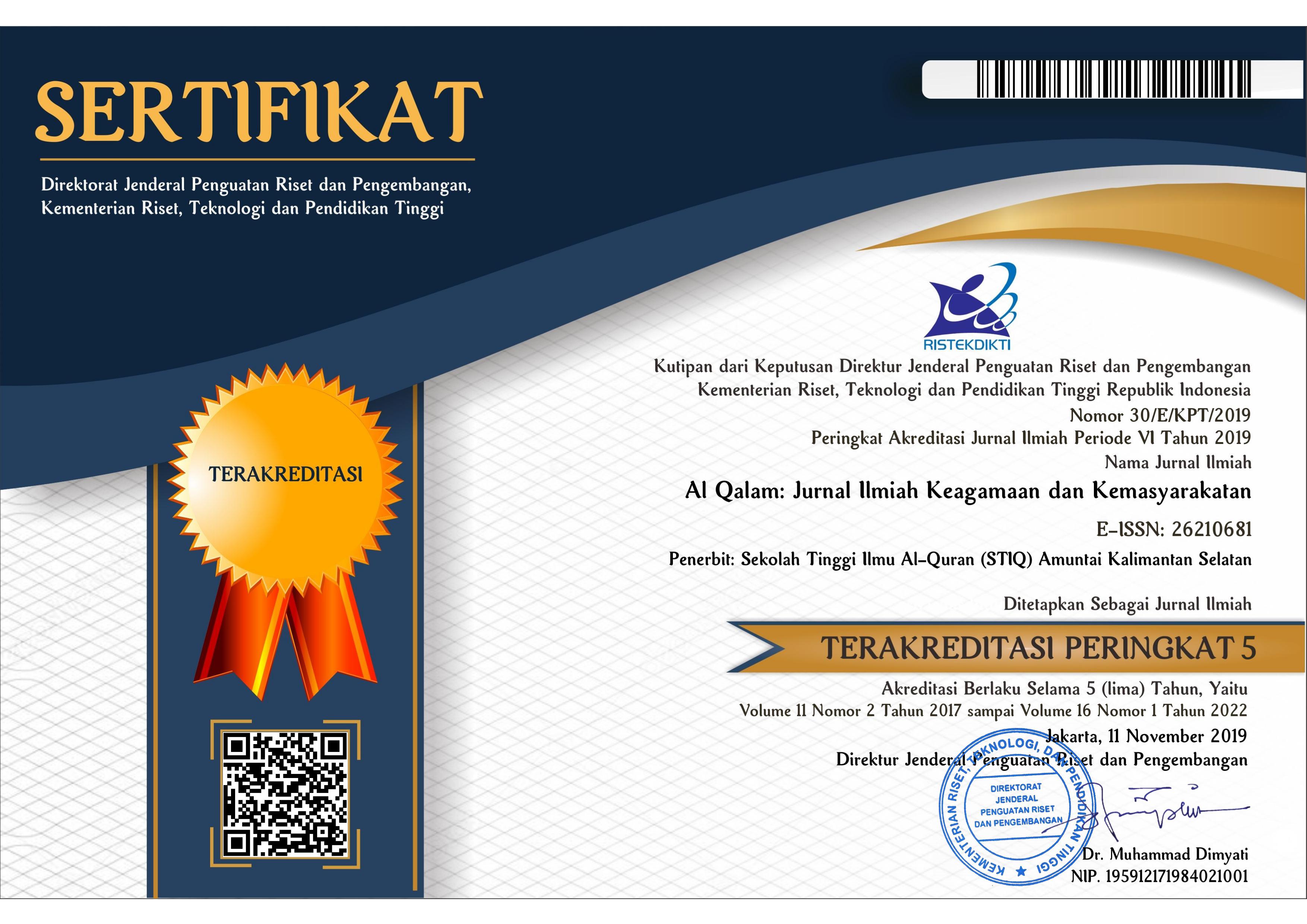
Al Qalam: Jurnal Ilmiah Keagamaan dan Kemasyarakatan
index by:





Publish by:
Sekolah Tinggi Ilmu Al-Qur'an Amuntai
Contact us:
Address: Jl. Rakha Pakapuran, Amuntai Utara
Kabupaten : Hulu Sungai Utara
Kode Pos : 71471
Provinsi : Kalimantan Selatan
Telephone : 085251613000
Email: hafizhihusinsungkar@gmail.com

This work is licensed under a Creative Commons Attribution 4.0 International License