


The Role of Muhammadiyah Autonomous Organizations in Developing Young Generation Leadership in the Society 5.0 Era in Bima
Abstract
The development of the Society 5.0 era presents both challenges and opportunities for developing young generation leadership, particularly in facing the acceleration of technology, social change, and the demands of 21st-century competencies. The Muhammadiyah autonomous organization holds a strategic position as a forum for cadre development and leadership development of the young generation based on Islamic and national values. This study aims to analyze the role of the Muhammadiyah autonomous organization in developing young generation leadership in Bima in the Society 5.0 era. This study uses a qualitative approach with a descriptive-analytical research type. Data collection was conducted through in-depth interviews, observation, and documentation of the administrators and members of the Muhammadiyah autonomous organization in Bima. Data analysis was conducted using Nvivo-15 with open coding, which is presented in the form of project maps. The results of the study indicate that the Muhammadiyah autonomous organization plays an active role in developing young generation leadership through tiered cadre development, internalization of ideological values, and strengthening leadership capacity that is adaptive to technological developments and social dynamics. This study concludes that the Muhammadiyah autonomous organization contributes significantly to preparing a young generation with character, competitiveness, and responsiveness to the challenges of Society 5.0.
Keywords
Full Text:
PDFReferences
Abdussamad, Zuchri. Metode Penelitian Kualitatif. Edited by Patta Rapanna. CV. Syakir Media Press, 2021.
Achmad, A. K. “Teachers’ Pedagogical Skills to Instill Islamic and Muhammadiyah Values to Face the Era of Society 5.0.” Proceedings Series on Social Sciences & Humanities 5 (2024): 1–11. https://doi.org/10.21070/pssh.v5i.491.
Adlini, M. N., A. H. Dinda, S. Yulinda, O. Chotimah, and S. J. Merliyana. “Metode Penelitian Kualitatif Studi Pustaka.” Edumaspul: Jurnal Pendidikan 6, no. 1 (2022): 974–80. https://doi.org/10.33487/edumaspul.v6i1.3394.
Ainun, A., F. Fitriani, S. Saifuddin, N. Nurma, N. Nasaruddin, and R. Ruslan. “Pendekatan Psikologis Dalam Pendidikan Islam: Menjawab Tantangan Pendidikan Di Era Digital.” Action Research Journal Indonesia (ARJI) 7, no. 4 (2025): 2763–78. https://doi.org/10.61227/arji.v7i4.576.
Al-Ansi, A. M., T. Sulistyaningsih, M. A. Wibowo, and A. Garad. “The Islamic Organizations in Indonesia ‘Muhammadiyah and NU’: Social Perspective Explanation.” Dirasat: Human and Social Sciences 50, no. 5 (2023): 550–64. https://doi.org/10.35516/hum.v49i1.1691.
Anggraeni, L., and F. Mukhlis. “Penguatan Literasi Islam Dan Sains Sebagai Peningkatan Wawasan Generasi Muda Islami Era Society 5.0 Di Ikatan Pemuda Muhammadiyah Kota Batu.” Jurnal Pengabdian Pada Masyarakat 8, no. 2 (2023): 478–89. https://doi.org/10.30653/jppm.v8i2.327.
Asy’ari, P. Z. Ilma, Z. W. D. Tinta, and Y. Mahlullah. “Pemberdayaan Angkatan Muda Muhammadiyah (AMM) Upaya Meningkatkan Keikutsertaan Dalam Pengembangan Organisasi Dan Branding PCM Tambaksari Surabaya.” Society: Jurnal Pengabdian Dan Pemberdayaan Masyarakat 3, no. 1 (2022): 45–58. https://doi.org/10.37802/society.v3i1.235.
Auliya, Z., I. D. P. Sari, L. E. Putri, I. E. Afando, W. Wismanto, and W. Ramashar. “Muhammadiyah Dan Transformasi Pendidikan Di Era Modern.” Jurnal Manajemen Dan Pendidikan Agama Islam 3, no. 1 (2025): 152–60. https://doi.org/10.61132/jmpai.v3i1.835.
Dadi, K. K. “Karakter Kepemimpinan Generasi Muda Indonesia Dalam Masyarakat 5.0.” Credendum: Jurnal Pendidikan Agama Katolik 6, no. 1 (2024): 102–12. https://doi.org/10.61902/credendum.v6i1.781.
Diniah, H. N. “Peran Organisasi IPM Dalam Menumbuhkan Karakter Muhammadiyah Di Pondok Pesantren.” Jurnal Pendidikan Tambusai 7, no. 3 (2023): 2273–92.
Fikri, H. A., M. U. Azmi, and A. R. Gushadyantoro. “Dalam Merevitalisasi Generasi Muda Nasionalis Di Era Disrupsi Digital.” Jurnal Studi Agama Dan Masyarakat 5, no. 1 (2023): 45–56.
Geza, W., M. S. C. Ngidi, R. Slotow, and T. Mabhaudhi. “The Dynamics of Youth Employment and Empowerment in Agriculture and Rural Development in South Africa: A Scoping Review.” Sustainability 14, no. 9 (2022). https://doi.org/10.3390/su14095041.
Ghobakhloo, M., H. A. Mahdiraji, V. Iranmanesh, and M. Jafari-Sadeghi. “From Industry 4.0 Digital Manufacturing to Industry 5.0 Digital Society: A Roadmap toward Human-Centric, Sustainable, and Resilient Production.” Information Systems Frontiers 26, no. 2 (2024): 481–501. https://doi.org/10.1007/s10796-024-10476-z.
Hutami, W. T., A. Mashudi, F. V. Revikasyah, and N. Nurhayati. “Muhammadiyah Dalam Pengembangan Pendidikan Islam Di Indonesia.” Masterpiece: Journal of Islamic Studies and Social Sciences 2, no. 1 (2024): 23–28. https://doi.org/10.62083/fdmjww02.
Ilham, M., S. Syahril, and E. Hadiati. “Pembinaan Akhlakul Karimah Remaja Untuk Menghadapi Tantangan Era Society 5.0 Di MAN 1 Lampung Timur.” Pendas: Jurnal Ilmiah Pendidikan Dasar 10, no. 4 (2025): 556–61. https://doi.org/10.23969/jp.v10i4.29916.
Islah, K. “Proses Kaderisasi Pembentukan Generasi Milenial Cendekia Yang Berjiwa Agile Leadership Pada Organisasi Di Era 4.0.” Kebijakan: Jurnal Ilmu Administrasi 13, no. 2 (2022): 118–28. https://doi.org/10.23969/kebijakan.v13i2.5276.
Kahardani, M. Z., N. Sudibjo, R. Pramono, and J. D. Tan. “Leadership of Millennial Women in Muhammadiyah Elementary Schools: A Multi-Specific Study of Elementary Schools in Yogyakarta City, Indonesia.” Journal of Educational and Social Research 15, no. 1 (2025): 861–74. https://doi.org/10.36941/jesr-2025-0068.
Kolade, Oluwaseun, and Adebowale Owoseni. “Employment 5.0: The Work of the Future and the Future of Work.” Technology in Society 71, no. August (2022): 102086. https://doi.org/10.1016/j.techsoc.2022.102086.
Kusumastuti, A., and A. M. Khoiron. Metode Penelitian Kualitatif. Lembaga Pendidikan Sukarno Pressindo (LPSP), 2019.
Linansera, Z. R. “Teologi Pastoral Dan Pendidikan Karakter: Peran Gereja Dalam Membentuk Generasi Emas Di Era Society 5.0.” Credendum: Jurnal Pendidikan Agama Katolik 6, no. 2 (2024): 33–42. https://doi.org/10.61902/credendum.v6i2.890.
Mourtzis, D., J. Angelopoulos, and N. Panopoulos. “A Literature Review of the Challenges and Opportunities of the Transition from Industry 4.0 to Society 5.0.” Energies 15, no. 17 (2022). https://doi.org/10.3390/en15176260.
Mukti, A. T. S. “Meningkatkan Karakter Kepemimpinan Era Milenial Di SMA Negeri 1 Parigi.” Jurnal Kepemimpinan Pendidikan 1, no. 1 (2024): 12–22.
Palguna, I. G. B. W., S. L. Nugraha, A. K. Satria, and A. N. Hidayah. “Peran Muhammadiyah Dalam Mencetak Generasi Unggul Melalui Pendidikan.” Fathir: Jurnal Studi Islam 2, no. 1 (2025): 82–95.
Prabowo, A. “Revolusi Perkembangan Digitalisasi Sebagai Aspek Membangun Karakter Pemuda Muhammadiyah Kreatif Dan Inovatif.” Jurnal Pemikiran Islam 3, no. 1 (2023): 110–22.
Pratiwi, A., and M. S. Hadi. “The Urgency of Siti Bariyah’s Thinking in Islamic Education 5.0.” Journal of Contemporary Islamic Education 2, no. 2 (2022): 148–62.
Rahardjo, M. Triangulasi Dalam Penelitian Kualitatif. Universitas Islam Negeri Maulana Malik Ibrahim Malang, 2010.
Ramadhan, R., and R. B. Siswoyo. “Pemberdayaan Pemuda Melalui Pengembangan Karakter Berbasis Organisasi Kewilayahan.” Jurnal Pemberdayaan Masyarakat 5, no. 1 (2024): 1–11.
Rohayati, N. “Peranan Muhammadiyah Dalam Membina Generasi Muda Melalui Pendidikan Karakter Di Sukajadi Kota Bandung.” Jurnal Pendidikan Universitas Garut 2, no. 1 (2013): 116–25.
Syafi’i, I. “Aktualisasi Sila Pertama Terhadap Karakter Religius Generasi Muda Di Era Society 5.0.” Jurnal Kajian Pendidikan Islam (JKPI) 14, no. 2 (2024): 171–82. https://doi.org/10.15642/jkpi.2024.14.2.171-182.
Tirtoni, F. “Implementasi Nilai-Nilai Pancasila Sebagai Karakter Dasar Siswa Sekolah Dasar.” Inventa: Jurnal Pendidikan Guru Sekolah Dasar 6, no. 2 (2022): 210–24. https://doi.org/10.25273/inventa.v6i2.13451.
Tóth, A., L. Nagy, R. Kennedy, B. Belej, and J. Abonyi. “The Human-Centric Industry 5.0 Collaboration Architecture.” MethodsX 11 (2023). https://doi.org/10.1016/j.mex.2023.102260.
Yusuf, M. S., and R. Romelah. “Implementasi Pembelajaran Kemuhammadiyahan Di SMK Muhammadiyah Ngawen.” Jurnal Pendidikan Muhammadiyah 2, no. 1 (2025): 45–55.
Zhanbayev, R. A., M. Irfan, A. V. Shutaleva, and D. G. Maksimov. “Demoethical Model of Sustainable Development of Society: A Roadmap towards Digital Transformation.” Sustainability 15, no. 4 (2023). https://doi.org/10.3390/su15043210.
DOI: http://dx.doi.org/10.35931/aq.v20i4.6856
Refbacks
- There are currently no refbacks.
Copyright (c) 2026 Ihlas Ihlas, Hendra Hendra, Amma Ainun, Uswatun Hasanah, Iyayun Amaliah, Mukmin Mukmin

This work is licensed under a Creative Commons Attribution 4.0 International License.
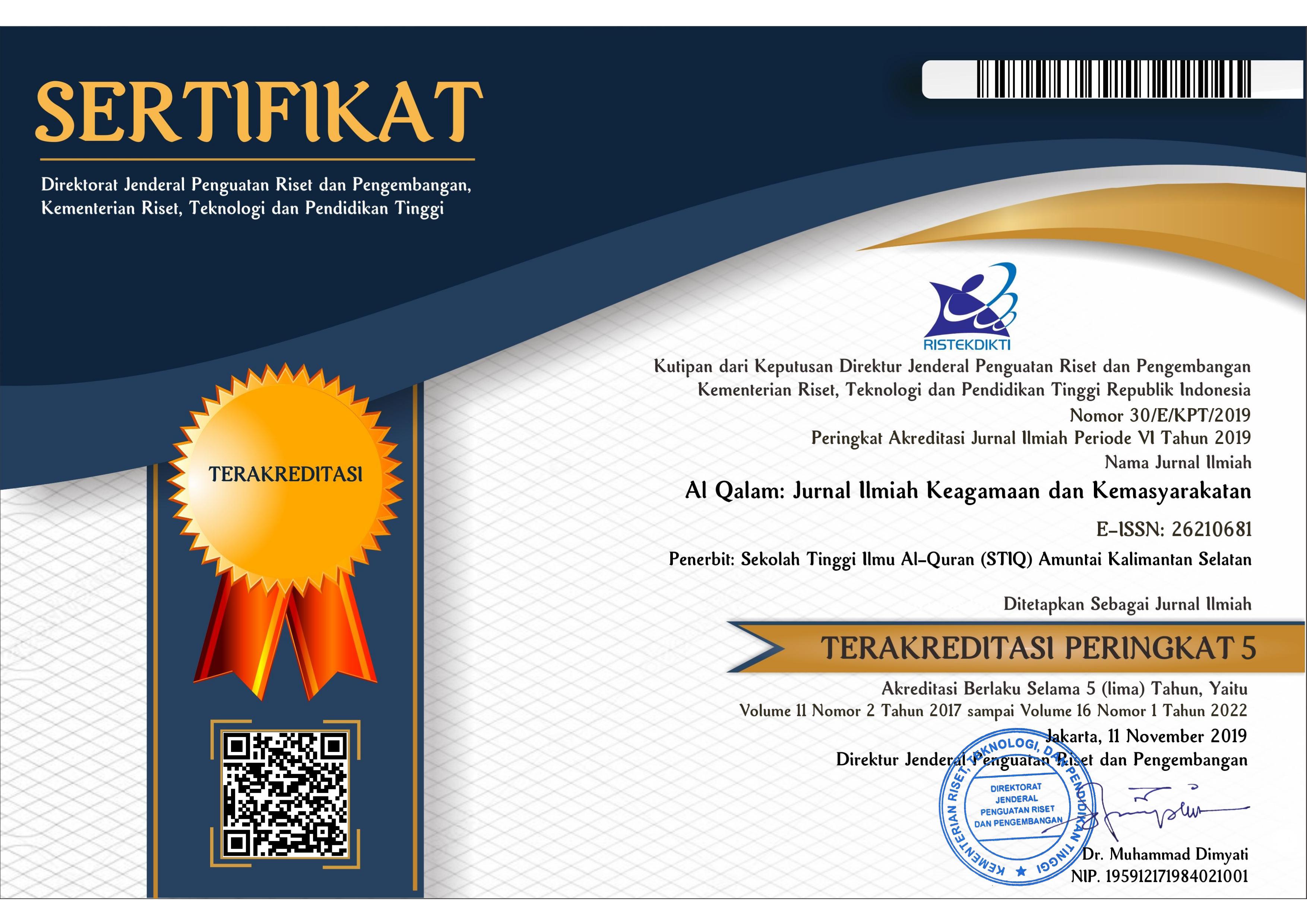
Al Qalam: Jurnal Ilmiah Keagamaan dan Kemasyarakatan
index by:








Publish by:
Sekolah Tinggi Ilmu Al-Qur'an Amuntai
Contact us:
Address: Jl. Rakha Pakapuran, Amuntai Utara
Kabupaten : Hulu Sungai Utara
Kode Pos : 71471
Provinsi : Kalimantan Selatan
Telephone : 085251613000
Email: hafizhihusinsungkar@gmail.com

This work is licensed under a Creative Commons Attribution 4.0 International License