


Singlehood among Generation X Men in Cungkup, Lamongan: A Fiqh al-Awlawiyyat Perspective
Abstract
Singlehood among Generation X has become an increasingly prominent social reality amid changes in family structures, economic dynamics, and shifts in social and religious values. In religious communities, the choice to remain unmarried is often seen as a deviation from the ideal norm of marriage, yet in practice the decision is frequently based on rational considerations, social responsibilities, and an orientation toward a meaningful and beneficial life. This study analyzes singlehood among Generation X men from the perspective of fiqh al-awlawiyyat (the jurisprudence of priorities), which emphasizes setting priorities in practicing Islamic teachings on the basis of benefit (maslahah) and the individual’s real circumstances. The study employs a qualitative approach, with data collected through in-depth interviews with ten unmarried men in Cungkup Village, Lamongan, and a review of the literature. The findings indicate that singlehood among these men is not rooted in a rejection of marriage but represents a form of personal ijtihad in weighing priorities among religious devotion, family responsibilities, economic stability, and social contribution. From the perspective of fiqh al-awlawiyyat, the choice to remain unmarried can be understood as a contextual decision that does not contradict Islamic values as long as it aims to secure benefit and prevent harm (mafsadah). This study is expected to enrich the discourse on social jurisprudence and to foster a more inclusive understanding of singlehood in contemporary Muslim societies.
Keywords
Full Text:
PDFReferences
Akbar, Wahyu, and Athoillah Islamy. “Fikih Prioritas dalam Fatwa Kehalalan Vaksin Covid-19 di Indonesia.” Al Iqtishod: Jurnal Pemikiran dan Penelitian Ekonomi Islam 10, no. 2 (2022): 37–54.
Al Farisi, Salman. “Childfree dalam Perspektif Fiqh al-Aulawiyyat.” Maqasid: Jurnal Studi Hukum Islam 10, no. 2 (2021): 1–9. https://journal.um-surabaya.ac.id/Maqasid/article/view/16059.
Annisa, Romadoni Kun, Belladiena Azmi, and Achmad Chusairi. “Alasan Individu Melajang: Sebuah Studi Literatur.” Buletin Riset Psikologi dan Kesehatan Mental 5, no. 1 (2025): 83–100.
Aryono, Marcella Mariska, and Robik Anwar Dani. “Hubungan Psychological Well Being dengan Loneliness pada Lansia yang Memilih Melajang.” Proyeksi: Jurnal Psikologi 14, no. 2 (2019): 162–71. https://doi.org/10.30659/jp.14.2.162-171.
Awaluddin, Ahmad In’am. “The Phenomenon of Early Marriage and Marriage Postponement in Indonesia from the Perspective of Maslahah Mursalah.” Maddika: Journal of Islamic Family Law 6, no. 1 (2025): 33–46. https://doi.org/10.24256/maddika.v6i1.6624.
Dedi, Dedi, Athoillah Islamy, and Abdul Aziz Harahap. “Paradigma Fikih Prioritas dalam Fatwa Ekonomi Syariah di Indonesia.” Jurnal el-Qanuniy: Jurnal Ilmu-Ilmu Kesyariahan dan Pranata Sosial 8, no. 1 (2022): 75–90.
Fadhillah, Raissa Putri, Azka Zakiya Syahidah, Rimadhanti Nuringtyas, and Dyah Siti Septianingsih. “Decision Making to Delay Marriage of Women in Early Adult Phase.” In Proceedings of the 2nd International Seminar on Psychology 4 (2019): 114–22.
Frelians, Pricilla Pascadeany, and RA Vita Astuti. “Manajemen Komunikasi Stigma pada Perempuan Lajang.” Jurnal Ilmu Komunikasi 21, no. 1 (2024): 57–72.
Gazadinda, Rahmadianty, Maria Mutiara, and Christina Pasaribu. “Pengaruh Kesepian dan Status Hubungan Romantis terhadap Kualitas Hidup pada Perempuan Lajang Dewasa Muda di Indonesia.” Jurnal Penelitian dan Pengukuran Psikologi 10, no. 2 (2021): 115–24.
Geist, Claudia. “Marriage Formation in Context: Four Decades in Comparative Perspective.” Social Sciences 6, no. 1 (2017): 9. https://doi.org/10.3390/socsci6010009.
Hadi, Bagus Kusumo, Robi’atin A’dawiyah, Abdul Qodir Zaelani, Arroyan Na’im, and Asyifa Nur Azizah. “The Phenomenon of Lifelong Singles in Indonesia: An Islamic Law and Psychological Health Study.” Usraty: Journal of Islamic Family Law 2, no. 2 (2024): 153–61. https://ejournal.uinbukittinggi.ac.id/usraty/article/view/8704.
Hasanuddin, Hasriah, Kiki Reski Amalia DT, M. Thahir Maloko, and Achmad Musyahid. “Menunda Pernikahan karena Karier: Analisis Fikih Kontemporer dan Maqashid Syari’ah.” Maqasid: Jurnal Studi Hukum Islam 15, no. 1 (2026): 162–74. https://journal.um-surabaya.ac.id/Maqasid/article/view/29811.
Himawan, Karel K. “Menikah adalah Ibadah: Peran Agama dalam Mengkonstruksi Pengalaman Melajang di Indonesia.” Jurnal Studi Pemuda 9, no. 2 (2020): 120–35. https://doi.org/10.22146/studipemudaugm.56548.
Ifandi, Teguh, and Idaul Hasanah. “Konsep Maslahat dan Mafsadah menurut Imam Al-Ghazali.” Tsaqafah 21, no. 1 (2024).
Kementerian Agama Republik Indonesia. Al-Qur’an dan Terjemahannya. Jakarta: Kementerian Agama RI, 2022. https://quran.kemenag.go.id/.
Maryanto, Gracetia Ratna Honesty, Karel Karsten Himawan, and Hanif Akhtar. “Self-Compassion Increases Life Satisfaction in Singles Who Want to Get Married.” ANIMA Indonesian Psychological Journal 39, no. 1 (2024): e06. https://doi.org/10.24123/aipj.v39i1.5493.
Meirina, Mega. “Hukum Perkawinan dalam Perspektif Hukum Positif dan Hukum Islam.” Ahkam: Jurnal Hukum Islam dan Humaniora 2, no. 1 (2023): 22–49. https://doi.org/10.58578/ahkam.v2i1.785.
Mohamad Sidik, Sofeeyah, Jonathan Han Loong Kuek, and Raihan Munira Moh Sani. “Exploring the Factors and Challenges of Involuntary Singlehood and Its Impact on Psychological Well-Being among Women in Malaysia.” Cogent Psychology 13, no. 1 (2026). https://doi.org/10.1080/23311908.2026.2623274.
Mortelmans, Dimitri, Elke Claessens, and Gert Thielemans. “Defining and Measuring Singlehood in Family Studies.” Journal of Family Theory & Review 15, no. 3 (2023): 485–505. https://doi.org/10.1111/jftr.12520.
Muñoz, Nayelli, and Mariana Torres. “Contexts of Loneliness in Women Choosing Voluntary Singlehood: A Qualitative Study in Mexico.” Psychology of Woman Journal 6, no. 4 (2025): 1–10. https://doi.org/10.61838/kman.pwj.4594.
Nabilah, Fadwa, and Ahmad Nurrohim. “Sakinah Resilien dalam QS. Ar-Rum [30]: 21: Rekonstruksi Makna Keluarga Sakinah melalui Pendekatan Tafsir Maqāṣidī.” Al-Hukmi: Jurnal Hukum Ekonomi Syari’ah dan Keluarga Islam 7, no. 1 (2026): 77–98.
Nahdhiyyah, Husnun. “Study of Fiqh Aulawiyat on Celibacy and Childfree in the Reality of Social Life.” Jurnal Al-Qadau: Peradilan dan Hukum Keluarga Islam 11, no. 1 (2024): 21–35. https://doi.org/10.24252/al-qadau.v11i1.48930.
Natasha, Siefra Andrea, and Dinie Ratri Desiningrum. “Wanita Lajang Dewasa Madya: Sebuah Studi dengan Pendekatan Interpretative Phenomenological Analysis.” Jurnal Empati 7, no. 1 (2020): 295–301.
Nurheliza, Siti, and Muhammad Amar Adly. “The Phenomenon of Marriage Delay in the Modern Era from an Islamic Law Perspective (Case Study of Master’s Students in Family Law at the State Islamic University of North Sumatra).” As-Sais: Jurnal Hukum Tata Negara/Siyasah 10, no. 1 (2026). https://doi.org/10.30821/as-sais.v10i1.28203.
Puspita, Mega, Wafiah Rafifatun Nida, Latifatul Ma’rifah, Ahdiyatul Hidayah, and Nur Luthfiyani Fajrin Mima. “Marriage Delay and Economic Rationality: A Socio-Theological Study on Poverty Fear among Young Indonesian Muslims.” Hayula: Indonesian Journal of Multidisciplinary Islamic Studies 10, no. 1 (2026): 21–52. https://doi.org/10.21009/hayula.010.01.02.
Rafliyanto. “Menimbang Moralitas dan Rasionalitas: Studi Kritis Fenomena Tren Nikah Muda dan Penundaan Perkawinan melalui Perspektif Maqashid Syariah dan Teori Tindakan Sosial Max Weber.” Jurnal Restorasi Hukum 8, no. 1 (2025): 134–66. https://doi.org/10.14421/v16nh673.
Rahardjo, Mudjia. Studi Kasus dalam Penelitian Kualitatif: Konsep dan Prosedurnya. Malang: UIN Maulana Malik Ibrahim, 2017.
Yosefina, Vida Jessica, and Megawati Batubara. “Intergenerational Climate menurut Generasi X dan Generasi Y pada Karyawan PT. TI.” Jurnal Psikologi Sains dan Profesi 5, no. 3 (2021): 192–202.
Zulfikar, Eko. “Tinjauan Tafsir Ahkam tentang Hukum Pernikahan dalam Al-Qur’an Surat Al-Nur Ayat 32–33.” Mahkamah: Jurnal Kajian Hukum Islam 5, no. 2 (2020): 1–16.
DOI: http://dx.doi.org/10.35931/aq.v20i6.7599
Refbacks
- There are currently no refbacks.
Copyright (c) 2026 Fitri Uswatun Mahzumah, Salman Al Farisi, Thoat Setiawan

This work is licensed under a Creative Commons Attribution 4.0 International License.
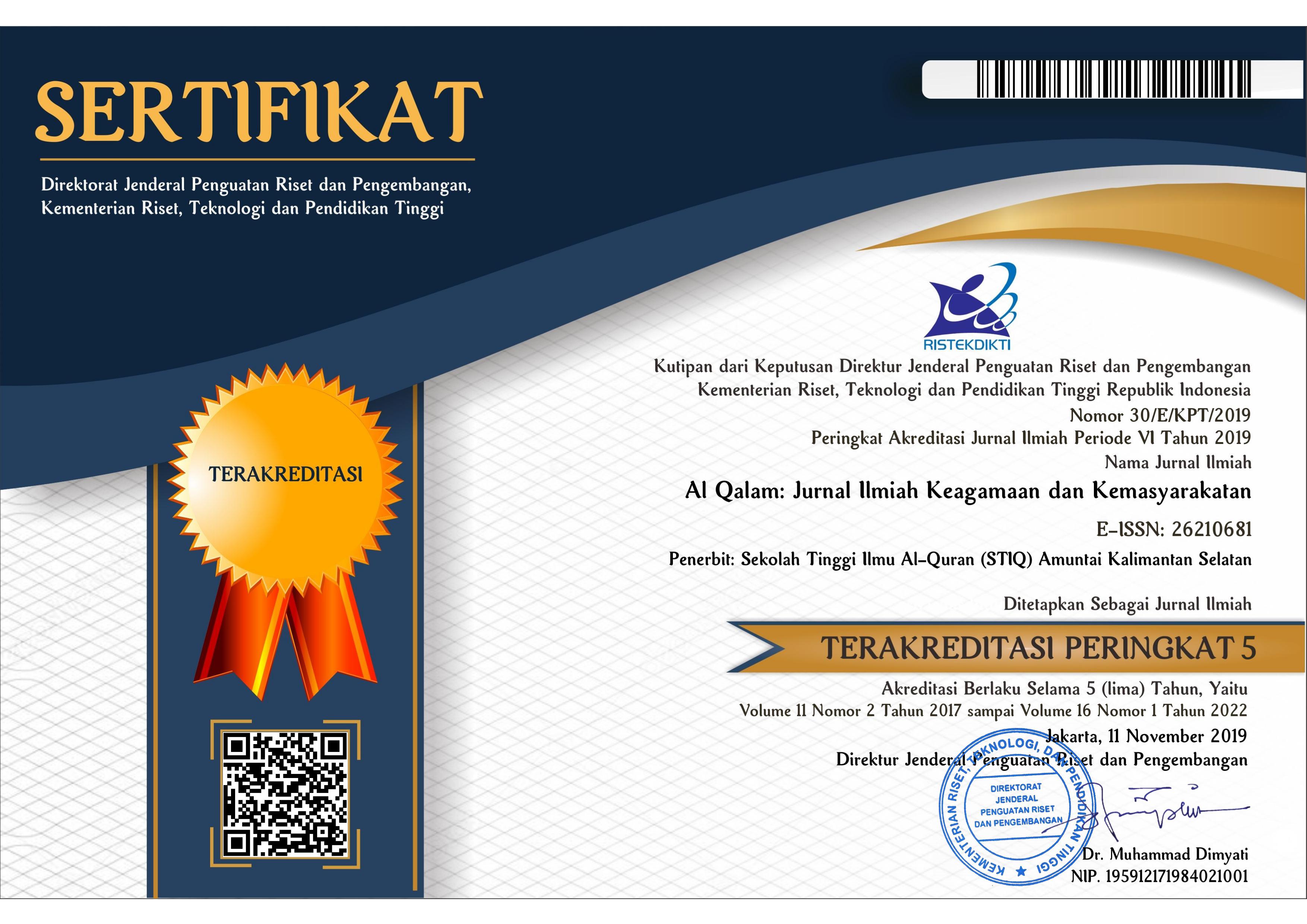
Al Qalam: Jurnal Ilmiah Keagamaan dan Kemasyarakatan
index by:







Publish by:
Sekolah Tinggi Ilmu Al-Qur'an Amuntai
Contact us:
Address: Jl. Rakha Pakapuran, Amuntai Utara
Kabupaten : Hulu Sungai Utara
Kode Pos : 71471
Provinsi : Kalimantan Selatan
Telephone : 085251613000
Email: hafizhihusinsungkar@gmail.com

This work is licensed under a Creative Commons Attribution 4.0 International License